Dumbbell Deadlift: Proper Form, Sets, Muscles Worked & Tips
Learn how to perform the Dumbbell Deadlift with proper hip-hinge mechanics to build glutes, hamstrings, and lower-back strength. Includes setup, execution steps, sets and reps by goal, mistakes, FAQs, and recommended equipment.
Dumbbell Deadlift
This variation is a great entry point for lifters who want the benefits of deadlift training without the complexity of a heavily loaded barbell setup. The dumbbells allow a more natural arm position, make it easier to learn the hip hinge, and provide an effective way to train strength, hypertrophy, and movement quality. Focus on keeping your spine neutral, your core braced, and your hips doing most of the work.
Quick Overview
| Body Part | Back, Glutes, Hamstrings |
|---|---|
| Primary Muscle | Glutes and Hamstrings |
| Secondary Muscle | Spinal erectors, core stabilizers, forearms, quadriceps, lats |
| Equipment | Pair of dumbbells |
| Difficulty | Beginner to Intermediate |
Sets & Reps (By Goal)
- Technique practice: 2–4 sets × 8–10 reps with light to moderate weight and full control
- Muscle growth: 3–4 sets × 8–12 reps with controlled eccentrics and strong hip extension
- Strength focus: 4–5 sets × 4–6 reps using heavier dumbbells without losing hinge mechanics
- General fitness: 2–3 sets × 10–15 reps with smooth tempo and consistent tension
Progression rule: Add load only after you can keep the dumbbells close, maintain a neutral spine, and feel the glutes and hamstrings doing most of the work from rep to rep.
Setup / Starting Position
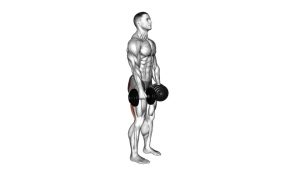
- Stand tall with the dumbbells at your sides or just in front of your thighs: Feet about hip-width apart with weight balanced through the mid-foot.
- Brace the torso: Pull your ribs down, tighten your midsection, and keep your chest open without over-arching the lower back.
- Set the shoulders: Let the arms hang straight while keeping the shoulders packed and the upper back engaged.
- Unlock the knees: Use a soft knee bend, but do not turn the movement into a squat.
- Prepare to hinge: Think “hips back” before the dumbbells move downward.
Tip: The best setup usually feels like a loaded standing position, not a crouch. The knees bend a little, but the hips drive the pattern.
Execution (Step-by-Step)
- Push the hips back: Start the rep by sending the hips behind you while keeping the spine neutral and the dumbbells close to the legs.
- Lower under control: Let the torso lean forward as the dumbbells travel down toward the knees and shins. Keep a slight knee bend and avoid collapsing the chest.
- Feel the stretch: Lower until you feel tension in the hamstrings while still maintaining a flat back and strong brace.
- Drive through the floor: Reverse the movement by pressing through the feet and extending the hips forward.
- Stand tall: Finish upright with the glutes squeezed and the dumbbells back near thigh level, without leaning backward excessively.
Pro Tips & Common Mistakes
- Keep the dumbbells close: The farther the weights move away from your body, the more stress shifts toward the lower back.
- Hinge, don’t squat: Too much knee bend turns the exercise into a squat-like pattern and reduces posterior-chain emphasis.
- Maintain a neutral spine: Avoid rounding your back on the way down or hyperextending at the top.
- Use the hips to lift: Think about driving the floor away and pushing the hips forward rather than yanking the dumbbells up with the arms.
- Control the eccentric: The lowering phase builds technique and tension. Don’t let the weights drop fast.
- Keep the neck neutral: Look slightly ahead or down, not up toward the ceiling.
- Don’t rush the lockout: Finish tall with glutes engaged, but avoid leaning back aggressively.
FAQ
What muscles does the Dumbbell Deadlift work the most?
The main muscles are the glutes and hamstrings. The spinal erectors, core, and forearms also work hard to stabilize the movement.
Is the Dumbbell Deadlift the same as a Dumbbell Romanian Deadlift?
They are very similar. In practice, many people use the names interchangeably. A Romanian-style version usually emphasizes a controlled eccentric and a stronger hamstring stretch, while a standard dumbbell deadlift may start slightly lower and allow a bit more knee bend.
How low should I lower the dumbbells?
Lower only as far as you can while keeping a neutral spine and clear hamstring tension. For many lifters, this is somewhere between just below the knees and mid-shin.
Should I feel this more in my back or my hamstrings?
You should mainly feel it in the glutes and hamstrings, with the lower back working more as a stabilizer. If your lower back dominates, your hinge pattern or loading may need adjustment.
Can beginners use the Dumbbell Deadlift?
Yes. It is often one of the best beginner-friendly deadlift variations because dumbbells are easier to manage and help lifters learn proper hip-hinge mechanics before moving to heavier barbell patterns.
Recommended Equipment
- Adjustable Dumbbells — versatile and space-saving for progressive loading as your deadlift strength improves
- Weightlifting Straps — helpful when grip becomes the limiting factor during heavier working sets
- Flat Weight Bench — useful for pairing deadlifts with rows, presses, and other dumbbell exercises in the same session
- Resistance Loop Bands — great for glute activation drills and warm-ups before hinge training
- Gym Floor Mat — protects flooring, improves setup comfort, and helps create a more stable home training area
Tip: Prioritize dumbbells with a secure grip and manageable weight jumps so you can progress technique and load without sacrificing form.