Resistance Band Overhead Side Bend: Core Form, Sets, Tips & FAQ
Learn the Resistance Band Overhead Side Bend to train obliques, core control, and side-body strength with safe form, sets, tips, FAQs, and gear.
Resistance Band Overhead Side Bend
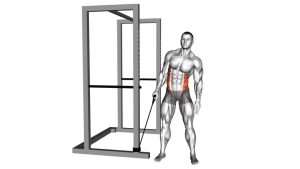
This exercise is useful for building lateral core strength, improving awareness of side bending mechanics, and teaching the torso to control tension through the ribs, waist, and hips. It works best when the movement stays slow, clean, and precise. The goal is not to bend as far as possible. The goal is to maintain a strong stance, keep the arms long, and control the band through the full range.
Quick Overview
| Body Part | Core |
|---|---|
| Primary Muscle | Obliques |
| Secondary Muscle | Transverse abdominis, quadratus lumborum, lats, shoulders, spinal stabilizers |
| Equipment | Resistance band and high anchor point |
| Difficulty | Beginner to Intermediate |
Sets & Reps (By Goal)
- Core activation: 2–3 sets × 8–10 reps per side with light band tension.
- Oblique strength: 3–4 sets × 10–15 reps per side with moderate tension.
- Control and mobility: 2–3 sets × 6–8 slow reps per side with a 2-second pause.
- Workout finisher: 2–3 sets × 15–20 reps per side using smooth continuous tempo.
Progression rule: Increase control first, then range, then band tension. Do not use a heavier band if your shoulders rise, hips shift, or torso rotates.
Setup / Starting Position
- Anchor the band high: Attach the resistance band to a secure overhead or high-side anchor.
- Stand side-on to the anchor: Position your body so the band pulls from one side and slightly above you.
- Grip the band with both hands: Extend your arms overhead with elbows straight or softly locked.
- Set your stance: Keep feet about shoulder-width apart with knees slightly soft.
- Brace your core: Keep ribs down, glutes lightly engaged, and spine tall before starting.
- Create band tension: Step away from the anchor until the band feels active but controllable.
Your starting position should feel stable. If the band pulls your shoulders out of position, move closer to the anchor or use a lighter band.
Execution (Step-by-Step)
- Start tall: Stand upright with the band overhead and your arms long.
- Brace gently: Tighten your midsection as if preparing to resist a side pull.
- Bend sideways: Slowly lean your torso away from the anchor while keeping your hips stable.
- Keep the motion clean: Move through the ribs and waist without twisting your chest forward or backward.
- Reach long through the arms: Keep the elbows extended and avoid letting the shoulders shrug.
- Pause briefly: Hold the end range for 1–2 seconds while maintaining control.
- Return to center: Use your obliques to pull your torso back to the upright position.
- Repeat smoothly: Complete all reps on one side, then turn around and train the opposite side.
Pro Tips & Common Mistakes
- Keep your arms long: Straight arms create a stronger lever and make the core work harder.
- Do not rush the return: The upward phase should be controlled, not snapped back by the band.
- Avoid twisting: Keep your chest facing forward instead of rotating toward the floor or ceiling.
- Control the ribs: Do not flare the ribcage or arch the lower back to gain extra range.
- Keep hips quiet: A small natural shift is fine, but the movement should not become a hip swing.
- Use light-to-moderate tension: Too much band resistance often causes shoulder shrugging and poor posture.
- Train both sides evenly: Perform the same number of reps on each side to balance the obliques.
FAQ
What muscles does the Resistance Band Overhead Side Bend work?
It mainly works the obliques. It also trains the transverse abdominis, quadratus lumborum, lats, shoulders, and spinal stabilizers because the band creates a long overhead resistance line.
Is this exercise good for obliques?
Yes. It is especially useful for training controlled side bending and oblique contraction. The overhead band position makes the movement more demanding than a basic bodyweight side bend.
Should I use a heavy resistance band?
Start with a light or moderate band. The goal is clean control, not maximum resistance. If your shoulders shrug, elbows bend, or torso twists, the band is too heavy.
Should the movement feel like a stretch or a core exercise?
It can feel like both. The side closest to the anchor may feel lengthened, while the opposite side works to control and return the torso. Keep the feeling muscular, not painful.
Can beginners do this exercise?
Yes, beginners can perform it with a light band and a small range of motion. Focus on posture, slow tempo, and stable hips before increasing resistance.
Recommended Equipment
- Resistance Bands with Handles — ideal for overhead gripping and controlled side-bend tension.
- Resistance Band Door Anchor — useful for creating a secure high anchor point at home.
- Loop Resistance Bands Set — helpful for core warm-ups, mobility drills, and band progressions.
- Non-Slip Exercise Mat — improves foot grip and stability during standing band movements.
- Resistance Band Wall Anchor — a more permanent anchor option for home gyms and cable-style band work.
Choose equipment that allows smooth resistance and a secure anchor. Never attach a band to an unstable object.