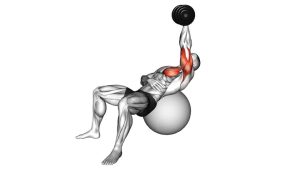
Cable One-Arm Incline Fly on Exercise Ball: Form, Sets & Pro Tips (Upper Chest)
Learn the cable one-arm incline fly on a stability ball to target the upper chest with constant tension and core control. Step-by-step form, sets by goal, mistakes, FAQs, and equipment.
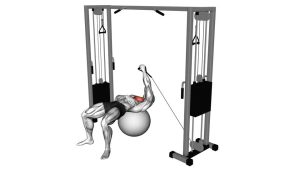
Cable One-Arm Incline Fly on Exercise Ball
This is a precision hypertrophy movement: use a load you can control without twisting on the ball. You should feel the chest doing most of the work, with your core quietly stabilizing. If your shoulder rolls forward, your elbow straightens into a press, or you lose balance, lower the weight and tighten your setup.
Quick Overview
| Body Part | Chest |
|---|---|
| Primary Muscle | Pectoralis major (upper/clavicular fibers) |
| Secondary Muscle | Anterior deltoid, serratus anterior, biceps (stabilization), core (anti-rotation) |
| Equipment | Cable machine (single handle), stability ball |
| Difficulty | Intermediate (unilateral control + instability demand) |
Sets & Reps (By Goal)
- Hypertrophy (main accessory): 3–4 sets × 10–15 reps/side (60–90 sec rest)
- Upper-chest emphasis (controlled squeeze): 3–4 sets × 8–12 reps/side (75–120 sec rest)
- Form + mind-muscle connection: 2–3 sets × 12–20 reps/side (45–75 sec rest)
- Finisher / pump work: 1–2 sets × 15–25 reps/side (short rest, strict form)
Progression rule: First add reps or slow the eccentric (2–3 seconds). Increase load only when you can keep the ball steady and the shoulder packed through the full range.
Setup / Starting Position
- Set the cable: Attach a single handle. Position the pulley low-to-mid (below chest level). Choose a moderate load.
- Place the ball: Sit with the stability ball behind you. Hold the handle with your working hand.
- Roll into incline: Walk your feet forward as you roll your upper back onto the ball. Create an incline torso angle (about 30–45°).
- Stabilize: Feet planted wide, glutes engaged, ribs down. Keep hips lifted so your body stays steady.
- Arm position: Start with the arm open in a fly position, elbow slightly bent, wrist neutral, shoulder down and back.
Tip: If balance is the limiting factor, widen your stance and slightly reduce the incline angle until you can keep the torso still.
Execution (Step-by-Step)
- Brace and set: Tighten core and glutes. Keep chest up and shoulder packed.
- Arc the arm inward: Sweep the arm in a wide arc up and across toward the upper-chest line (think “hug the air”).
- Maintain elbow angle: Keep the same soft bend—don’t turn it into a press.
- Squeeze: Stop just short of the midline and pause 1 second for a strong upper-chest contraction.
- Slow return: Control the eccentric as the arm opens back out. Stop when you feel a stretch in the chest—no shoulder dumping forward.
Pro Tips & Common Mistakes
- Lead with the elbow: Think “elbow drives the arc” to keep tension on the pec.
- Don’t cross too far: Stopping just short of center keeps the shoulder in a safer position while still squeezing hard.
- Own the eccentric: The slow return is where the upper chest grows—aim for 2–3 seconds down.
- Stay packed: Shoulder down/back; avoid rolling forward at the bottom stretch.
- Keep the ball stable: If you’re wobbling, lower the weight or widen your stance.
- Avoid turning it into a press: If the elbow straightens a lot, you’ve shifted to triceps/pressing.
- Best placement: After incline pressing or machine pressing, as a strict isolation accessory.
FAQ
Where should I feel this exercise?
Primarily in the upper chest on the working side, with a smooth stretch at the bottom and a strong squeeze at the top. You’ll also feel your core stabilizing to resist rotation from the cable.
Is the stability ball necessary?
It’s optional but valuable. The ball adds an instability challenge that improves core control and makes unilateral work more demanding. If balance limits you, perform the same movement on an incline bench first.
Should I cross the hand over my body?
Slightly is fine, but you don’t need a big crossover. For most lifters, stopping just short of the midline delivers a great squeeze while keeping the shoulder comfortable.
What if I feel it more in my front shoulder than my chest?
Lower the load, reduce the bottom range, keep the shoulder packed, and maintain a soft elbow bend. Focus on moving in an arc (not pressing). A small torso angle adjustment can also help.
How do I progress this exercise safely?
Add reps first, then slow the eccentric or add a 1-second squeeze at the top. Increase weight only if you can keep the ball stable and maintain perfect shoulder position.
Recommended Equipment (Optional)
- Anti-Burst Stability Ball — improves incline positioning and adds core stability demand
- Single D-Handle Cable Attachment — comfortable grip for strict single-arm fly mechanics
- Door Anchor + Resistance Bands (Travel Alternative) — useful substitute when a cable machine isn’t available
- Thick Non-Slip Exercise Mat — keeps feet planted and improves stability during ball work
- Lifting Straps (Optional) — helpful if grip limits your fly control on higher-rep sets
Tip: Use equipment that improves control and stability—this is a form-first isolation movement.