Kettlebell Russian Twist: Form, Core Benefits, Sets, Tips & FAQ
Learn the Kettlebell Russian Twist for stronger obliques, better core control, and rotational stability with safe form, sets, tips, FAQs, and gear.
Kettlebell Russian Twist
This exercise works best when the movement comes from a controlled torso rotation rather than loose arm swinging. Although the kettlebell moves side to side, your shoulders, ribs, and trunk should rotate together. As a result, the exercise builds stronger obliques while also improving rotational stability for sports, lifting, and everyday movement.
Quick Overview
| Body Part | Core |
|---|---|
| Primary Muscle | Obliques |
| Secondary Muscle | Rectus abdominis, transverse abdominis, hip flexors, spinal stabilizers |
| Equipment | Kettlebell and exercise mat |
| Difficulty | Intermediate |
Sets & Reps (By Goal)
- Core control: 2–3 sets × 8–12 reps per side with a slow, clean tempo.
- Muscular endurance: 3–4 sets × 12–20 reps per side with light-to-moderate load.
- Strength focus: 3–5 sets × 6–10 reps per side using a heavier kettlebell only if form stays stable.
- Finisher: 2–3 rounds × 30–45 seconds with controlled breathing and no rushing.
Progression rule: First improve control, then increase reps, and only after that increase kettlebell weight. If your feet lift uncontrollably or your lower back rounds, reduce the load immediately.
Setup / Starting Position
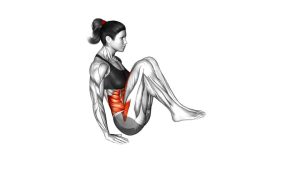
- Sit on the floor: Bend your knees and position your feet in front of you.
- Hold the kettlebell: Grip the kettlebell securely with both hands near the horns or sides of the handle.
- Lean back slightly: Create a controlled angle through the torso while keeping the spine long.
- Brace your core: Tighten the abs as if preparing for a light punch to the stomach.
- Start at center: Keep the kettlebell in front of your torso before beginning the twist.
Tip: Keep the kettlebell close enough to control. The farther it moves away from your torso, the harder it becomes to resist momentum.
Execution (Step-by-Step)
- Begin from the center: Sit tall, lean back slightly, and hold the kettlebell in front of your midsection.
- Rotate to one side: Turn your torso as the kettlebell moves toward the outside of your hip.
- Control the end range: Pause briefly without collapsing your chest or rounding your back.
- Return through center: Bring the kettlebell back across your body using your obliques, not momentum.
- Rotate to the opposite side: Repeat the same controlled twist in the other direction.
- Continue alternating: Keep each rep smooth, balanced, and consistent from side to side.
Pro Tips & Common Mistakes
- Rotate the torso, not only the arms: Your shoulders and ribs should turn with the kettlebell.
- Avoid rounding the lower back: Stay long through the spine and keep your chest lifted.
- Do not slam the weight side to side: Use control instead of bouncing or dropping the kettlebell.
- Keep the abs braced: A strong brace protects the lower back and improves oblique engagement.
- Use a manageable kettlebell: Too much weight usually turns the exercise into a sloppy swing.
- Breathe steadily: Exhale gently as you rotate, then inhale as you pass through the center.
- Keep the movement symmetrical: Rotate evenly to both sides instead of favoring your stronger side.
FAQ
What muscles does the Kettlebell Russian Twist work?
The exercise mainly targets the obliques. In addition, it trains the rectus abdominis, transverse abdominis, hip flexors, and spinal stabilizers because your body must resist collapsing while rotating.
Should my feet be on the floor or lifted?
Both options can work. However, keeping your feet on the floor is usually better for learning control. Lifting the feet increases difficulty, so use that version only when your torso stays stable.
Is the Kettlebell Russian Twist good for abs?
Yes. It can strengthen the abs and obliques, especially when performed with slow rotation and proper bracing. However, it should not replace anti-rotation drills, planks, or full-body strength training.
Why do I feel it in my lower back?
Lower-back discomfort usually happens when the spine rounds, the kettlebell is too heavy, or the movement becomes too fast. Reduce the weight, sit taller, and rotate through a smaller range.
How heavy should the kettlebell be?
Choose a light-to-moderate kettlebell that allows full control. For many beginners, a lighter kettlebell is better because clean rotation matters more than heavy loading.
Recommended Equipment
- Kettlebell — the main tool for performing the weighted Russian twist.
- Adjustable Kettlebell — useful for progressing gradually without buying multiple weights.
- Exercise Mat — adds comfort and grip while sitting on the floor.
- Workout Gloves — can improve grip comfort during kettlebell handling.
- Core Sliders — helpful for adding other core stability drills to your routine.
Tip: Start with a kettlebell you can control without leaning too far back, twisting aggressively, or losing your posture.