Landmine Single-Arm Press: Form, Muscles Worked, Sets, Tips & FAQ
Learn how to do the Landmine Single-Arm Press with proper form. Discover muscles worked, setup, execution steps, sets and reps by goal, common mistakes, FAQs, and recommended equipment.
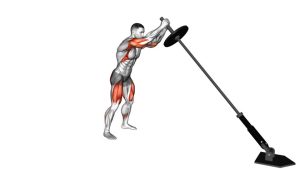
Landmine Single-Arm Press
This movement is ideal for lifters who want to build pressing strength with a more natural bar path. Since you work one arm at a time, the exercise also challenges your torso to resist twisting, making it useful for improving coordination, side-to-side balance, and total-body control. Keep the rep smooth, stay tall through the torso, and press the bar up and slightly forward rather than trying to force it into a straight overhead line.
Quick Overview
| Body Part | Front Shoulders |
|---|---|
| Primary Muscle | Anterior deltoid |
| Secondary Muscle | Upper chest, triceps, serratus anterior, obliques, and core stabilizers |
| Equipment | Barbell, landmine base or corner setup, weight plates |
| Difficulty | Beginner to Intermediate |
Sets & Reps (By Goal)
- Muscle growth: 3–4 sets × 8–12 reps per side
- Strength: 4–5 sets × 4–6 reps per side
- Technique and control: 2–4 sets × 6–10 reps per side with a slow tempo
- Warm-up activation: 2–3 sets × 10–12 light reps per side
Progression rule: Increase weight only after you can press both sides with the same smooth path, stable torso position, and no compensatory lean.
Setup / Starting Position
- Set the bar: Place one end of a barbell in a landmine attachment or secure corner setup.
- Stand tall: Position your feet about shoulder-width apart for a stable base.
- Grip the sleeve end: Hold the loaded end of the bar with one hand at shoulder level.
- Elbow position: Keep your elbow slightly in front of the body, not flared straight out to the side.
- Brace the core: Tighten your abs and glutes to prevent leaning back during the press.
- Keep the wrist stacked: Maintain a neutral wrist so the hand stays directly behind the bar.
Tip: A staggered stance can help some lifters feel more stable, but a square stance works well if you can resist rotation cleanly.
Execution (Step-by-Step)
- Start from the shoulder: Begin with the bar close to the front of the shoulder and the torso upright.
- Drive the bar up and forward: Press along the natural diagonal landmine path until the arm is nearly straight.
- Keep the ribs down: Avoid excessive lower-back extension as the bar rises.
- Stay square: Do not rotate the torso toward the working arm.
- Pause briefly: Control the top position without shrugging excessively.
- Lower with control: Bring the bar back to shoulder level smoothly and repeat for the target reps before switching sides.
Pro Tips & Common Mistakes
- Press on a diagonal path: Let the landmine guide the bar instead of forcing it vertically.
- Do not lean back: Excessive backward lean shifts stress away from the shoulder and into the lower back.
- Keep the core engaged: The torso should resist rotation throughout every rep.
- Do not flare the elbow too wide: A slightly tucked pressing angle is usually stronger and more shoulder-friendly.
- Control the eccentric: Lowering the bar slowly improves stability and keeps tension on the target muscles.
- Use even reps per side: Match volume left to right to reduce side-to-side imbalances.
- Start lighter than you think: Unilateral landmine pressing often feels harder than bilateral pressing because of the stabilization demand.
FAQ
What muscles does the Landmine Single-Arm Press work?
It primarily targets the front deltoid, while the upper chest, triceps, and core stabilizers assist during the press.
Is the Landmine Single-Arm Press better than a dumbbell shoulder press?
Not necessarily better, but different. The landmine variation offers a more angled pressing path that many lifters find more comfortable on the shoulders, especially if strict overhead pressing feels awkward.
Should I do this exercise standing or half-kneeling?
Standing is great for full-body coordination and anti-rotation control. Half-kneeling can be useful if you want more core focus and less chance of compensatory leaning.
How heavy should I go?
Start with a load you can move smoothly without torso twisting, rib flare, or lower-back arching. Clean mechanics matter more than loading the bar aggressively too soon.
Can beginners use the Landmine Single-Arm Press?
Yes. It is often beginner-friendly because the fixed arc can make pressing mechanics easier to learn than a fully vertical overhead press.
Recommended Equipment
- Landmine Attachment for Barbell — the key tool for creating a smooth 360° landmine pressing setup
- Barbell Collars — helps keep plates secure during pressing and setup changes
- Fractional Weight Plates — useful for making small progressive overload jumps without disrupting technique
- Resistance Bands Set — excellent for shoulder warm-ups, pull-aparts, and activation work before pressing
- Foam Exercise / Knee Pad — helpful for half-kneeling landmine press variations and more comfortable floor contact
Tip: The best first purchase for this exercise is a solid landmine attachment. After that, small plates, collars, and warm-up tools make progression and setup easier.