Band Kneeling Twisting Crunch: Form, Benefits, Sets, Tips & FAQ
Learn the Band Kneeling Twisting Crunch to train abs and obliques with resistance. Includes setup, steps, sets, mistakes, FAQ, and equipment.
Band Kneeling Twisting Crunch
This exercise is useful for building stronger abs, sharper oblique control, and better rotational strength without needing a cable machine. Because the band creates tension from above, your core must work through the full range of motion. The movement should feel like a controlled curl and twist of the trunk, not a fast arm pull.
The best reps are slow, deliberate, and compact. Start tall on both knees, brace your midsection, then crunch diagonally toward one side. As you return, resist the band instead of letting it pull you upward quickly. This controlled return strengthens your abs through the eccentric phase and keeps the exercise safer.
Quick Overview
| Body Part | Core |
|---|---|
| Primary Muscle | Obliques |
| Secondary Muscle | Rectus abdominis, transverse abdominis, deep spinal stabilizers |
| Equipment | Resistance band and a secure high anchor point |
| Difficulty | Intermediate |
Sets & Reps (By Goal)
- Core control: 2–3 sets × 8–10 reps per side with a slow tempo.
- Oblique strength: 3–4 sets × 10–12 reps per side using moderate band tension.
- Muscle endurance: 2–4 sets × 12–15 reps per side with lighter resistance.
- Warm-up activation: 1–2 sets × 8–10 reps per side before heavier core or rotational work.
- Home ab workout finisher: 2–3 sets × 12–20 total alternating reps with clean control.
Progression rule: Add reps first, then increase band tension. Do not progress if you lose torso control, rotate with momentum, or feel the exercise mainly in your arms or lower back.
Setup / Starting Position
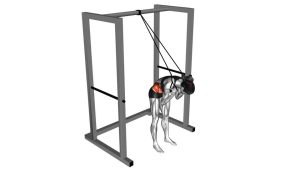
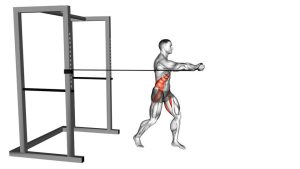
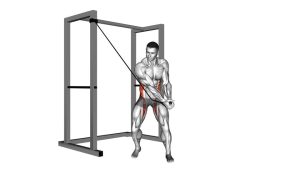
- Anchor the band high: Attach the resistance band to a secure point above head height. Make sure the anchor will not slip during the pull.
- Kneel below the anchor: Position both knees on the floor with your body slightly away from the anchor so the band has light tension at the start.
- Hold the band firmly: Grip the band with both hands near the sides of your head, forehead, or upper chest depending on comfort.
- Stack your body: Keep your hips over your knees, ribs down, glutes lightly engaged, and spine tall.
- Brace before moving: Exhale slightly, tighten your abs, and prepare to crunch diagonally instead of pulling only with your arms.
A folded mat or knee pad can make the kneeling position more comfortable. If your knees feel unstable, widen your knee stance slightly.
Execution (Step-by-Step)
- Begin tall: Start in an upright kneeling position with the band under light tension and your elbows bent.
- Initiate from the core: Pull your ribs down and begin crunching forward. Let the abs start the movement before the arms pull.
- Twist diagonally: Rotate your torso toward one side as you crunch. Aim your elbows or hands toward the outside of the opposite knee.
- Reach peak contraction: Pause briefly when your abs and obliques are fully contracted. Keep the hips steady and avoid collapsing into the lower back.
- Return with control: Slowly rise back to the starting position while resisting the band. Do not let the band snap you upward.
- Repeat on the same side: Complete all reps on one side before switching, or alternate sides if your goal is rhythm and coordination.
Pro Tips & Common Mistakes
- Crunch before you pull: Start the rep by shortening your abs, then let the arms guide the band.
- Keep your hips quiet: Your hips should not rock backward or twist aggressively. The rotation should come mostly from the torso.
- Use a diagonal path: Pull down and across, not straight down. This diagonal line helps load the obliques more effectively.
- Do not rush the return: The upward phase is where many people lose tension. Move slowly and keep the abs engaged.
- Avoid over-rotation: More twist is not always better. Rotate only as far as you can control without shifting your knees or lower back.
- Keep the neck relaxed: Do not yank your head forward. Your hands should guide the band, not pull your neck.
- Control your breathing: Exhale during the crunch and inhale as you return to the tall kneeling position.
- Choose the right band: A band that is too heavy will turn the drill into an arm pull. Use enough resistance to challenge the core without breaking form.
FAQ
What muscles does the Band Kneeling Twisting Crunch work?
The main muscles are the obliques. The rectus abdominis also helps create the crunching motion, while the transverse abdominis and spinal stabilizers help control the trunk.
Is this exercise good for obliques?
Yes. The twisting motion makes this exercise especially useful for oblique training. The band adds resistance through the diagonal crunch, which helps build strength and control.
Should I do this exercise fast or slow?
Slow is better for most goals. A controlled tempo helps you feel the abs and obliques working. Fast reps often shift the work into the arms, shoulders, and lower back.
Can beginners do the Band Kneeling Twisting Crunch?
Beginners can do it with a very light band, but they should first learn basic kneeling crunches and controlled trunk rotation. If the twisting pattern feels confusing, reduce the range and practice slowly.
Why do I feel this exercise in my arms?
You may be pulling the band down with your hands instead of crunching with your core. Keep the arms fixed near your head or chest, then move your ribs toward your hip as you rotate.
Can this replace cable twisting crunches?
Yes, it can be a strong home-friendly alternative. A cable machine gives smoother tension, but a resistance band still provides effective loading when anchored securely and performed with control.
Recommended Equipment
- Resistance Bands Set — provides different tension levels for progression and core training.
- Door Anchor for Resistance Bands — helps create a secure high anchor point for kneeling band crunch variations.
- Thick Exercise Mat — supports the knees and improves comfort during kneeling exercises.
- Exercise Knee Pad — adds extra cushioning if regular mats are not enough for kneeling work.
- Resistance Band Handles — improves grip comfort when using bands for repeated crunch and rotation drills.
Choose equipment that allows smooth tension and safe anchoring. The anchor point matters more than heavy resistance for this exercise.