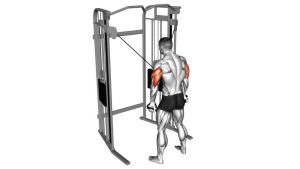
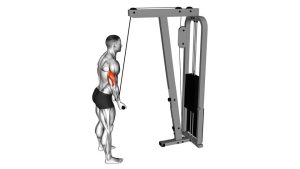
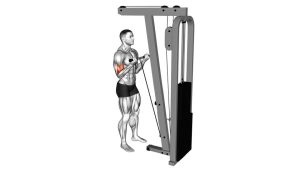
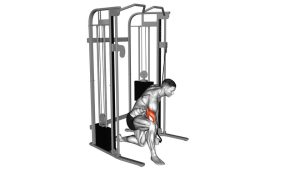
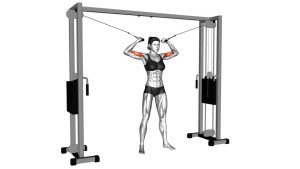
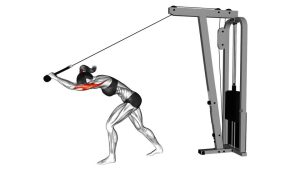
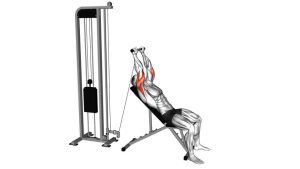
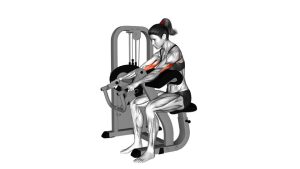
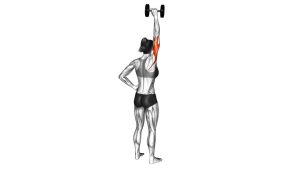
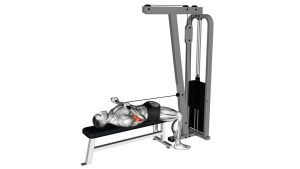
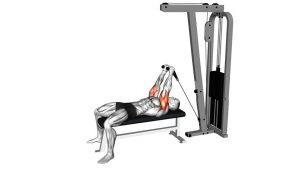
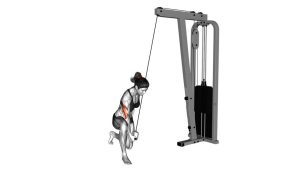
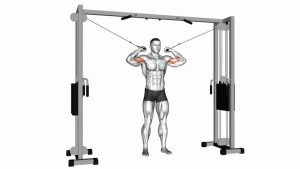
Cable Standing One-Arm Triceps Extension: Form, Sets, Tips & FAQ
Learn the Cable Standing One-Arm Triceps Extension for better arm isolation, elbow control, and triceps development. Includes setup, step-by-step form, sets by goal, common mistakes, FAQs, and recommended Amazon equipment.
Cable Standing One-Arm Triceps Extension
This exercise works best when the upper arm stays quiet and the forearm does the moving. You should feel the triceps doing most of the work, especially near full extension. Avoid turning it into a shoulder-driven push or using torso swing to move the handle. Controlled reps will usually beat heavier sloppy reps here.
Quick Overview
| Body Part | Triceps |
|---|---|
| Primary Muscle | Triceps brachii |
| Secondary Muscle | Anconeus, forearm stabilizers, shoulder stabilizers, core |
| Equipment | Cable machine with a high pulley and single D-handle attachment |
| Difficulty | Beginner to Intermediate |
Sets & Reps (By Goal)
- Muscle growth: 3-4 sets × 8-15 reps per arm, 45-75 seconds rest
- Technique and control: 2-3 sets × 10-15 reps per arm, slow tempo, light-to-moderate load
- Arm finisher: 2-3 sets × 12-20 reps per arm, short rest, strong squeeze at lockout
- Strength emphasis: 3-5 sets × 6-10 reps per arm, controlled reps, no body swing
Progression rule: Add reps first, then small weight increases. Only move up when you can keep the elbow fixed, finish the lockout cleanly, and control the eccentric on every rep.
Setup / Starting Position
- Set the pulley high: Attach a single handle to the top pulley position.
- Take your grip: Use one hand with a neutral grip and step into a stable standing stance.
- Align the arm: Keep your elbow close to your side and bent roughly to a right angle at the start.
- Brace the torso: Stand tall with ribs down, chest open, and core lightly engaged.
- Set cable tension: Start with the cable already under light tension so there is no slack.
Tip: A slight split stance can make it easier to stay balanced and stop the torso from rocking during harder sets.
Execution (Step-by-Step)
- Lock in posture: Keep your shoulders down and back, wrist neutral, and elbow tucked near the torso.
- Extend the elbow: Press the handle downward by straightening the arm until the triceps fully contract.
- Pause briefly: Squeeze at the bottom without hyperextending or snapping the elbow.
- Return with control: Let the handle rise slowly as the elbow bends back to the start position.
- Repeat smoothly: Maintain tension throughout the set and avoid letting the weight pull you out of position.
Pro Tips & Common Mistakes
- Pin the elbow: The more stable your upper arm is, the more direct the triceps tension usually feels.
- Use a full but controlled range: Don’t cut the rep short at the bottom or rush the return.
- Keep the wrist straight: A bent wrist often shifts tension away from the target area.
- Don’t swing the torso: Momentum turns an isolation lift into a sloppy whole-body movement.
- Don’t shrug the shoulder: Keep the shoulder quiet so elbow extension stays the main action.
- Train both sides evenly: Start with your weaker arm and match that performance on the stronger side.
FAQ
What does the Cable Standing One-Arm Triceps Extension target?
It mainly targets the triceps brachii. Because it is done one arm at a time, it is also useful for improving arm symmetry and helping you focus on strict elbow extension.
Should my elbow stay glued to my side?
It should stay close and controlled. A tiny amount of natural movement is fine, but large elbow drift usually reduces isolation and makes the shoulder do more work.
Is this better than two-arm pushdowns?
Not always better, but different. The single-arm version is excellent for identifying imbalances, improving control, and getting a stronger contraction on each side independently.
How heavy should I go?
Use a load that lets you fully extend the elbow without leaning, twisting, or jerking the handle down. If the body starts helping, reduce the weight and clean up the rep quality.
Can beginners use this exercise?
Yes. It is beginner-friendly as long as the weight is manageable and the setup is stable. Start light and focus on smooth, repeatable mechanics before trying to chase heavier loads.
Recommended Equipment
- Single D-Handle Cable Attachment — the most direct attachment choice for one-arm cable triceps extensions
- Triceps Rope Attachment — useful for pushdowns, rope extensions, and other triceps cable variations
- Resistance Bands Set — a practical backup for home triceps work and higher-rep accessory training
- Door Anchor Training System — helpful if you want to mimic cable-style elbow extension work at home
- Wrist Wraps — optional support if your wrists get irritated during cable arm work
Tip: For this specific exercise, the best first purchase is usually a single D-handle. A rope is the best second option if you want more triceps exercise variety.