Standing Pelvic Tilt: Proper Form, Core Control, Tips & FAQ
Learn the Standing Pelvic Tilt for core control, glute activation, and pelvic alignment. Includes form cues, sets, mistakes, FAQs, and gear.
Standing Pelvic Tilt
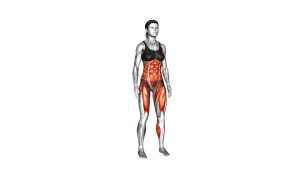
This exercise is useful for learning posterior pelvic tilt control, improving body awareness, and practicing better standing alignment. Although the movement looks small, it requires precise coordination between the abdominals, glutes, and lower-back position. Because the video shows a slow and controlled standing version, every rep should stay smooth, quiet, and easy to repeat.
Quick Overview
| Body Part | Core |
|---|---|
| Primary Muscle | Abdominals, especially deep core stabilizers |
| Secondary Muscle | Glutes, hip stabilizers, and lower-back stabilizers |
| Equipment | None |
| Difficulty | Beginner |
Sets & Reps (By Goal)
- Movement learning: 2–3 sets × 8–12 slow reps, resting 30–45 seconds between sets.
- Core activation warm-up: 2 sets × 10–15 controlled reps before lower-body or core training.
- Posture practice: 1–3 sets × 8–10 reps during the day, especially after long sitting periods.
- Control-focused training: 2–4 sets × 6–10 reps with a 2–3 second pause at the posterior tilt.
Progression rule: First, improve control and consistency. Then, add a short pause at the tilted position before increasing reps.
Setup / Starting Position
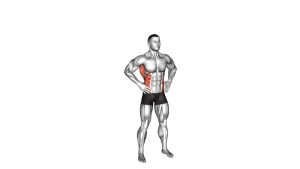
- Stand tall: Place your feet about hip-width apart and keep your body upright.
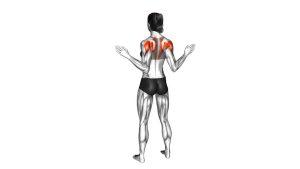
- Relax your arms: Let your arms hang naturally by your sides, as shown in the video.
- Set your ribs: Keep your ribcage stacked over your pelvis instead of flaring the chest upward.
- Find neutral: Begin with a natural lower-back curve, without exaggerating the arch.
- Prepare gently: Lightly brace your midsection and keep the shoulders relaxed before starting the tilt.
Tip: If you cannot feel the pelvis moving, practice in front of a mirror so you can see the small change in hip position.
Execution (Step-by-Step)
- Start in neutral: Stand upright with your head, ribs, and pelvis aligned.
- Begin the tilt: Slowly rotate your pelvis backward, as if gently tucking the tailbone under.
- Flatten slightly: Allow the lower-back arch to reduce without bending the knees or leaning the torso.
- Engage lightly: Squeeze the glutes gently and keep the abdominals active, but avoid hard bracing.
- Pause briefly: Hold the tilted position for 1–3 seconds while staying tall.
- Return with control: Slowly rotate the pelvis back to neutral and restore the natural lower-back curve.
- Repeat smoothly: Continue for the target reps without bouncing, rushing, or using momentum.
Pro Tips & Common Mistakes
- Keep the movement small: A pelvic tilt is a control drill, not a large hip thrust or squat.
- Avoid leaning back: The torso should stay upright while the pelvis rotates.
- Do not lock the knees hard: Keep the legs stable, but avoid stiff, uncomfortable tension.
- Use the glutes lightly: A gentle squeeze helps the pelvis tuck, but excessive squeezing can create stiffness.
- Control the return: Do not release quickly into an exaggerated lower-back arch.
- Breathe naturally: Exhale as you tilt, then inhale as you return to neutral.
- Watch for rib flare: If the ribs lift, reconnect the ribs and pelvis before the next rep.
FAQ
What is the Standing Pelvic Tilt?
The Standing Pelvic Tilt is a bodyweight exercise where you rotate the pelvis backward and return to neutral while standing. It helps improve pelvic awareness, core control, and lower-back positioning.
Where should I feel this exercise?
You may feel light work in the lower abdominals and glutes. However, it should not feel like sharp pressure in the lower back. If it does, reduce the range and slow the movement down.
Is this exercise good for posture?
Yes, it can support posture practice because it teaches you how to control pelvic position while standing. However, it works best when combined with core strengthening, glute training, and regular movement breaks.
Should I squeeze my glutes hard?
No. Use a gentle glute contraction to guide the pelvis. If you squeeze too hard, the movement may become stiff and less controlled.
Can beginners do Standing Pelvic Tilts?
Yes. This is a beginner-friendly exercise because it uses no equipment and has a small range of motion. Still, beginners should move slowly and focus on control instead of speed.
Recommended Equipment (Optional)
- Exercise Mat — useful if you also practice pelvic tilts on the floor.
- Full-Length Posture Mirror — helps you check pelvic position and avoid torso leaning.
- Resistance Bands Set — helpful for pairing pelvic control with glute and hip stability work.
- Yoga Blocks — useful for mobility drills and supported posture practice.
- Foam Roller — helpful for general hip, glute, and lower-back recovery work.
Tip: Equipment is optional for this exercise. However, simple tools can help you build a more complete core, hip, and posture routine.