Russian Twist on Stability Ball Arms Straight: Core Form, Sets, Tips & FAQ
Learn the Russian Twist on Stability Ball Arms Straight to train obliques, core control, balance, and trunk rotation with safe form.
Russian Twist on Stability Ball Arms Straight
This exercise is best performed with a smooth tempo, stable hips, and a strong bridge position. Unlike a floor Russian twist, this variation challenges balance because the ball moves slightly underneath the upper back. Therefore, your goal is not to twist as far as possible. Instead, rotate with control, keep your hips lifted, and let your ribs, shoulders, and arms move together as one connected unit.
Quick Overview
| Body Part | Core |
|---|---|
| Primary Muscle | Obliques |
| Secondary Muscle | Rectus abdominis, transverse abdominis, glutes, lower back stabilizers, shoulders |
| Equipment | Stability ball / Swiss ball / exercise ball |
| Difficulty | Intermediate |
Sets & Reps (By Goal)
- Core control: 2–3 sets × 8–10 reps per side with slow, clean rotation.
- Oblique strength: 3–4 sets × 10–12 reps per side while keeping the hips elevated.
- Balance and stability: 2–3 sets × 6–8 reps per side with a 1–2 second pause at each side.
- Conditioning finisher: 2–3 rounds × 20–30 total controlled reps.
Progression rule: First improve control and range. Then increase reps. After that, you may hold a light medicine ball or dumbbell, but only if your hips stay steady.
Setup / Starting Position
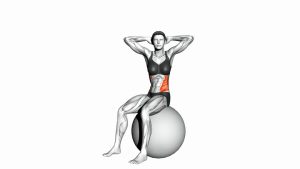
- Place the stability ball correctly: Sit on the ball, then walk your feet forward until your upper back and shoulder blades rest on top of it.
- Set your bridge: Keep your feet flat, knees bent, and hips lifted until your knees, hips, and shoulders form a strong line.
- Position your feet: Use a shoulder-width stance or slightly wider stance for better balance.
- Extend your arms: Bring your hands together and reach them straight above your chest.
- Brace your core: Gently tighten your abs as if preparing to resist movement through the waist.
- Relax your neck: Keep your head supported in line with your torso. Avoid pulling the chin forward.
Tip: The wider your feet are, the easier the exercise becomes. As your balance improves, bring your feet slightly closer together.
Execution (Step-by-Step)
- Start in the center: Keep your arms straight above your chest, hips lifted, and core braced.
- Rotate to one side: Turn your chest, shoulders, and arms together while keeping your hips as level as possible.
- Control the ball: Let the ball roll slightly under your upper back, but do not allow your body to collapse or slide.
- Pause briefly: Stop when you feel your obliques working and your balance still feels controlled.
- Return to center: Rotate back slowly without using momentum.
- Repeat to the other side: Move with the same speed, range, and control on both sides.
- Continue alternating: Keep each repetition smooth, stable, and deliberate.
Pro Tips & Common Mistakes
- Keep your hips lifted: If your hips drop, your lower back may take over. Squeeze your glutes lightly to hold the bridge.
- Rotate from the torso: The chest, ribs, shoulders, and arms should turn together as one unit.
- Avoid rushing: Fast reps reduce tension and increase the chance of losing balance.
- Do not over-rotate: Stop before your hips twist aggressively or your feet shift on the floor.
- Keep the neck neutral: Do not crane your head forward. Let the head follow the torso naturally.
- Use your feet for stability: Press evenly through both feet to prevent the ball from rolling too far.
- Breathe with control: Exhale gently as you rotate, then inhale as you return to center.
- Master bodyweight first: Adding weight too early often turns the exercise into a swing instead of a core drill.
FAQ
What muscles does the Russian Twist on Stability Ball Arms Straight work?
It mainly targets the obliques. However, it also trains the rectus abdominis, transverse abdominis, glutes, lower back stabilizers, and shoulders because the body must stay balanced on the ball.
Is this exercise better than a floor Russian twist?
It is not always better, but it is more challenging for balance and stability. The stability ball adds an unstable surface, so your core must control rotation while your glutes help maintain the bridge position.
Should my hips move during this exercise?
A small amount of movement can happen naturally. However, your hips should not drop, twist aggressively, or swing from side to side. Keep them lifted and controlled throughout the set.
Can beginners do this Russian twist variation?
Beginners can try it only if they already have good stability on a ball. Otherwise, start with dead bugs, floor Russian twists, or a basic stability ball bridge before progressing to this version.
Can I add weight to this exercise?
Yes, but only after you can perform the bodyweight version with excellent control. A light medicine ball, dumbbell, or weight plate can increase difficulty, but heavy loading may reduce form quality.
Why do I feel this in my lower back?
Lower-back discomfort often happens when the hips drop, the ribs flare, or the rotation becomes too large. Reduce your range, brace your abs, and keep your glutes active. If pain continues, stop the exercise.
Recommended Equipment
- Stability Ball / Swiss Ball — the main tool for this exercise and other balance-based core movements.
- Anti-Burst Exercise Ball — a safer, durable option for core training, bridges, and stability drills.
- Medicine Ball — useful for progressing the exercise once bodyweight control is mastered.
- Non-Slip Exercise Mat — helps keep the feet secure and improves comfort during stability ball training.
- Adjustable Dumbbells — optional for advanced weighted Russian twist progressions.
Tip: Choose a stability ball size that lets your knees bend close to 90 degrees when seated. A poorly sized ball can make setup harder and reduce control.