Half Squat Torso Punches: Form, Core Benefits, Sets & Tips
Learn Half Squat Torso Punches for core rotation, leg stability, and bodyweight conditioning with step-by-step form, tips, mistakes, and FAQs.
Half Squat Torso Punches
This exercise works best when the squat position remains steady and the punches stay controlled. Instead of bouncing through the legs or swinging the arms loosely, keep your feet planted, knees bent, and torso tall. Then, rotate from the trunk as one arm extends across the body and the opposite arm returns near the chest.
Quick Overview
| Body Part | Core |
|---|---|
| Primary Muscle | Obliques |
| Secondary Muscle | Rectus abdominis, shoulders, chest, quads, glutes |
| Equipment | No equipment |
| Difficulty | Beginner to intermediate |
Sets & Reps (By Goal)
- Core control: 2–3 sets × 10–16 total punches, using a slow and steady rhythm.
- Conditioning: 3–4 sets × 20–30 seconds, resting 30–60 seconds between sets.
- Leg endurance: 2–4 sets × 12–20 total punches while holding the half squat consistently.
- Warm-up activation: 1–2 sets × 8–12 total punches with easy effort and smooth rotation.
Progression rule: First improve control and posture. Then, increase total reps, time under tension, or tempo only if your knees stay stable and your torso rotation remains clean.
Setup / Starting Position
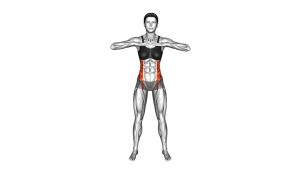
- Stand wide: Place your feet wider than hip-width, similar to the stance shown in the video.
- Bend into a half squat: Lower slightly by bending the knees while keeping your torso upright.
- Keep the feet planted: Maintain a stable base and avoid stepping during the movement.
- Bring the hands up: Hold both hands near the chest in a guard-like position.
- Brace lightly: Keep the ribs controlled and prepare to rotate through the torso.
The starting position should feel athletic and balanced. However, it should not feel like a deep squat or a lunge.
Execution (Step-by-Step)
- Start centered: Hold the half squat with both hands close to the chest.
- Rotate to one side: Turn your torso while extending one arm across the body into a punch.
- Keep the lower body stable: Let the torso move, but keep the knees bent and feet fixed.
- Return to the middle: Bring the punching arm back toward the chest and reset your torso.
- Switch sides: Rotate the opposite way and punch across the body with the other arm.
- Repeat rhythmically: Continue alternating sides while maintaining the same half-squat height.
Pro Tips & Common Mistakes
Pro Tips
- Stay low but controlled: Keep a half squat instead of standing up between punches.
- Rotate through the torso: Let the core guide the punch rather than only moving the arm.
- Use a smooth rhythm: Alternate sides with control instead of rushing each rep.
- Keep the chest lifted: Avoid collapsing forward as fatigue builds.
- Breathe naturally: Exhale lightly as you punch and inhale as you return to center.
Common Mistakes
- Standing up after each punch: This removes the lower-body stability challenge.
- Letting the knees cave inward: Keep the knees tracking in the same direction as the feet.
- Swinging the arms only: The movement should include visible torso rotation.
- Rounding the back: Maintain a tall torso and controlled rib position.
- Moving too fast: Speed is useful only after the form stays stable.
FAQ
What muscles do Half Squat Torso Punches work?
Half Squat Torso Punches mainly train the obliques because the torso rotates from side to side. Additionally, the shoulders and chest assist the punching action, while the quads and glutes help hold the half squat.
Is this exercise good for beginners?
Yes, it can be beginner-friendly when performed slowly. However, beginners should start with a shallow half squat, shorter punches, and a controlled tempo before increasing speed or duration.
Should my feet move during the exercise?
In the uploaded video, the feet stay planted throughout the movement. Therefore, keep your stance fixed and use your core to rotate rather than stepping or shifting excessively.
Can I use this exercise for cardio?
Yes. When performed continuously for time, Half Squat Torso Punches can raise the heart rate. Even so, form should stay controlled, especially through the knees, hips, and lower back.
How deep should the squat be?
The video shows a half-squat position, not a full squat. Aim for a moderate knee bend that lets you stay stable while rotating and punching with control.
Recommended Equipment (Optional)
- Exercise Mat — useful for warm-ups, cooldowns, and floor-based core work after this drill
- Resistance Bands Set — helpful for adding upper-body and core rotation progressions later
- Light Dumbbells — optional for advanced punching variations, only after bodyweight form is solid
- Training Shoes — provide grip and support during wide-stance standing exercises
- Interval Timer — useful for timed conditioning sets and structured workout rounds
Tip: This exercise does not require equipment. Therefore, use optional tools only when they improve safety, consistency, or workout structure.