Standing Core Twist: Proper Form, Oblique Benefits, Sets, Tips & FAQ
Learn the Standing Core Twist to train obliques, improve torso rotation, and build core control with step-by-step form, tips, FAQs, and gear.
Standing Core Twist
This exercise is best used as a core activation drill, warm-up movement, posture-control exercise, or beginner-friendly oblique builder. The goal is not to twist as far as possible. The goal is to rotate smoothly while keeping the spine tall, the arms level, and the hips mostly stable.
Quick Overview
| Body Part | Core |
|---|---|
| Primary Muscle | Obliques |
| Secondary Muscle | Transverse abdominis, rectus abdominis, erector spinae, shoulders |
| Equipment | No equipment required |
| Difficulty | Beginner |
Sets & Reps (By Goal)
- Beginner core activation: 2–3 sets × 10–12 twists per side
- Warm-up and mobility: 1–2 sets × 12–15 controlled twists per side
- Core endurance: 3–4 sets × 15–20 twists per side
- Slow control focus: 2–3 sets × 8–10 reps per side with a 1–2 second pause
Progression rule: First improve control, posture, and range quality. After that, progress by slowing the tempo, increasing reps, or adding light resistance.
Setup / Starting Position
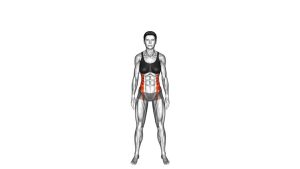
- Stand tall: Place your feet about shoulder-width apart with your weight balanced evenly.
- Extend the arms: Raise both arms out to the sides at shoulder height in a straight T-position.
- Brace lightly: Tighten your core as if preparing for a gentle punch to the stomach.
- Keep the ribs stacked: Avoid arching the lower back or flaring the ribs upward.
- Set your gaze: Keep your head aligned with your torso and avoid dropping the chin.
Your arms should stay long and level, but they should not drive the movement. The rotation should come from the torso.
Execution (Step-by-Step)
- Start in neutral: Stand upright with the chest facing forward and both arms extended sideways.
- Rotate the torso: Turn your ribcage and shoulders to one side while keeping your hips mostly forward.
- Control the end range: Stop when you feel a comfortable oblique contraction without forcing the spine.
- Return to center: Rotate back slowly until your chest faces forward again.
- Repeat to the other side: Twist in the opposite direction with the same smooth tempo and control.
Pro Tips & Common Mistakes
- Rotate from the core: Think about turning your ribcage instead of throwing your arms.
- Keep hips stable: A small amount of hip movement is normal, but avoid spinning the whole body.
- Stay tall: Do not lean forward, lean backward, or collapse through the lower back.
- Control the tempo: Slow, clean reps are better than fast, sloppy twists.
- Keep arms level: Avoid letting one arm drop as you rotate.
- Do not overtwist: Stop before the movement becomes forced or uncomfortable.
- Breathe naturally: Exhale gently during the twist and inhale as you return to center.
FAQ
What muscles does the Standing Core Twist work?
The Standing Core Twist mainly works the obliques. It also involves the transverse abdominis, rectus abdominis, spinal stabilizers, and shoulders for posture and control.
Is the Standing Core Twist good for beginners?
Yes. It is beginner-friendly because it uses bodyweight only and allows you to control the range of motion. Beginners should move slowly and avoid forcing the twist.
Should my hips move during the twist?
The hips should stay mostly stable. A small amount of natural movement is acceptable, but the main rotation should come from the torso and ribcage.
Can I do this exercise every day?
Yes, it can be done daily at low to moderate intensity, especially as a mobility or posture-control drill. Keep the movement smooth and avoid excessive volume if your back feels tired.
How can I make the Standing Core Twist harder?
You can slow the tempo, pause at the end of each twist, increase reps, or add light resistance with a resistance band, medicine ball, or light dumbbell.
Recommended Equipment (Optional)
- Resistance Bands Set — useful for progressing the movement into resisted torso rotations
- Exercise Mat — helps create a stable workout area for core training and warm-ups
- Light Medicine Ball — adds gentle resistance for more advanced rotational core work
- Lightweight Adjustable Dumbbells — optional for controlled loaded twist variations
- Balance Board / Core Trainer — useful for advanced balance and core stability progressions
Start with bodyweight first. Add equipment only when you can rotate smoothly without swinging, leaning, or losing posture.