Assisted Prone Hamstring Curl: Form, Benefits, Sets & Tips
Learn the Assisted Prone Hamstring Curl for stronger hamstrings, better knee flexion control, safe setup, form cues, mistakes, FAQs, and gear.
Assisted Prone Hamstring Curl
This exercise works best when the resistance is light, steady, and matched to the lifter’s strength. The goal is not to overpower the legs. The goal is to make the hamstrings work through a clean curl and a slow return. Keep the hips pressed down, keep the thighs on the floor, and move only from the knees.
Quick Overview
| Body Part | Hamstrings |
|---|---|
| Primary Muscle | Hamstrings: biceps femoris, semitendinosus, semimembranosus |
| Secondary Muscle | Calves, glutes, and lower-body stabilizers |
| Equipment | Exercise mat and training partner |
| Difficulty | Beginner to Intermediate |
Sets & Reps (By Goal)
- Beginner control: 2–3 sets × 8–10 reps with light partner resistance.
- Hamstring strength: 3–4 sets × 8–12 reps with moderate, smooth resistance.
- Eccentric control: 3 sets × 6–8 reps with a slow 3–5 second lowering phase.
- Warm-up activation: 1–2 sets × 10–15 reps using very light resistance.
Progression rule: Add control before adding resistance. Increase the lowering time, improve the squeeze, and only then ask your partner to apply slightly more resistance.
Setup / Starting Position
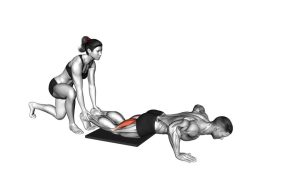
- Lie face down: Position your body on a mat with your legs extended and your hips flat.
- Set your upper body: Keep your chest relaxed and place your arms comfortably in front or beside you.
- Partner position: Your partner kneels behind your feet and lightly holds the ankles or lower calves.
- Start with straight legs: Keep both knees extended without locking them aggressively.
- Brace lightly: Keep the pelvis stable so the movement comes from knee flexion, not hip lifting.
The partner should stay close enough to control resistance smoothly, but not so close that they pull the ankles out of alignment.
Execution (Step-by-Step)
- Begin from full extension: Keep your thighs on the floor and prepare to bend only at the knees.
- Curl the heels upward: Flex your knees and bring your heels toward your glutes against your partner’s light resistance.
- Squeeze the hamstrings: Pause briefly near the top without lifting your hips or arching your lower back.
- Lower slowly: Extend your knees under control while your partner maintains steady resistance.
- Reset each rep: Return to the starting position smoothly before beginning the next curl.
Pro Tips & Common Mistakes
- Use smooth partner resistance: The partner should match your strength instead of pushing hard.
- Keep hips down: Lifting the hips turns the exercise into a compensation pattern and reduces hamstring isolation.
- Control the lowering phase: The eccentric portion is highly valuable for hamstring strength and control.
- Avoid fast reps: Quick swinging reduces tension and increases the chance of poor knee tracking.
- Keep ankles aligned: Do not let the partner twist the feet inward or outward during resistance.
- Stop before cramping: Hamstrings may cramp if the resistance is too high or the range is rushed.
FAQ
What muscles does the Assisted Prone Hamstring Curl work?
It mainly works the hamstrings, including the biceps femoris, semitendinosus, and semimembranosus. The calves and glutes assist lightly with stability.
Is this exercise good if I do not have a leg curl machine?
Yes. This is a practical alternative because the partner provides manual resistance while you perform the same basic knee-flexion action used in a prone leg curl.
How much resistance should the partner use?
The resistance should be moderate enough to challenge the curl but light enough that the lifter can move smoothly. The partner should never force the legs down or block the movement completely.
Should I feel this in my lower back?
No. The main sensation should be in the back of the thighs. If the lower back feels loaded, keep the hips down, reduce resistance, and avoid arching during the curl.
Can beginners do Assisted Prone Hamstring Curls?
Yes, beginners can use this exercise when the partner applies very light resistance and the movement stays slow. It is better to start easy and build control over time.
Recommended Equipment
- Exercise Mat — provides comfort for the chest, hips, knees, and legs during prone training.
- Padded Ankle Straps — useful for comfort if you later progress to cable or band hamstring curl variations.
- Resistance Bands Set — allows solo hamstring curl variations when a training partner is not available.
- Foam Roller — helpful for warming up and relaxing the posterior chain before or after training.
- Adjustable Ankle Weights — optional progression tool for controlled lower-body isolation exercises.
Choose equipment that supports clean movement and comfort. For this exercise, good control matters more than heavy resistance.