Suspender Straight Hip Leg Curl: Form, Sets, Tips & FAQ
Learn the Suspender Straight Hip Leg Curl for stronger hamstrings, glutes, and core control. Includes setup, reps, form tips, FAQs, and equipment.
Suspender Straight Hip Leg Curl
This exercise is more demanding than a basic floor hamstring curl because the straps create instability. Your hamstrings must bend the knees, your glutes must hold the hips in extension, and your core must prevent the lower back from arching or the pelvis from dropping. A clean rep should look smooth, controlled, and stable from the shoulders to the knees.
Quick Overview
| Body Part | Hamstrings |
|---|---|
| Primary Muscle | Hamstrings — biceps femoris, semitendinosus, semimembranosus |
| Secondary Muscle | Glutes, calves, core stabilizers, hip extensors |
| Equipment | Suspension trainer / straps |
| Difficulty | Intermediate to advanced |
Sets & Reps (By Goal)
- Strength control: 3–4 sets × 6–10 reps with a slow eccentric phase
- Muscle building: 3–4 sets × 8–12 reps with full hip height maintained
- Hamstring endurance: 2–3 sets × 12–15 reps using a controlled tempo
- Posterior-chain finisher: 2 sets × near technical failure, stopping before hip collapse
Progression rule: First improve control and hip height. Then increase reps, slow the lowering phase, or move farther from the anchor point to increase difficulty.
Setup / Starting Position
- Set the straps low: Adjust the suspension handles so the foot cradles hang close to the floor.
- Lie on your back: Position yourself supine with both heels inside the foot cradles.
- Extend the legs: Start with the knees mostly straight and the straps under light tension.
- Brace the upper body: Keep your arms on the floor beside your body for balance.
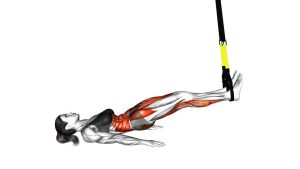
- Lift the hips: Drive through the heels and raise your hips into a bridge so the body forms a long line from shoulders to knees.
- Set your core: Keep the ribs down, pelvis level, and glutes lightly squeezed before starting the curl.
Your hips should stay elevated before the first rep begins. If the hips are resting on the floor, the movement becomes a much easier suspended leg curl variation.
Execution (Step-by-Step)
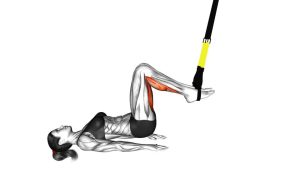
- Start in a bridge: Keep your hips lifted, core tight, and legs extended inside the straps.
- Curl the heels in: Bend your knees and pull your heels toward your glutes using your hamstrings.
- Keep the hips high: Do not let your pelvis sag as the knees bend.
- Pause at the top: Briefly squeeze the hamstrings when the heels are close to the glutes.
- Extend with control: Slowly straighten your legs back out while resisting the straps.
- Finish in the bridge: Return to the long-body position without dropping your hips to the floor.
Pro Tips & Common Mistakes
- Keep the hips extended: The straight-hip bridge position is what makes this version harder and more effective.
- Control the lowering phase: Do not let the legs shoot forward quickly. The eccentric phase builds strong hamstrings.
- Avoid lower-back arching: Brace the core and keep the ribs down as you curl.
- Do not swing the straps: Smooth movement keeps the tension on the hamstrings instead of momentum.
- Keep both legs even: Pull evenly through both heels to avoid twisting the pelvis.
- Stop before form breaks: When the hips start dropping, the set is finished.
- Use shorter reps if needed: Partial controlled reps are better than full reps with poor hip position.
FAQ
What muscles does the Suspender Straight Hip Leg Curl work?
It primarily works the hamstrings. The glutes, calves, and core also work hard to keep the hips lifted and the pelvis stable during the curl.
Is this exercise good for hamstring strength?
Yes. It trains the hamstrings through knee flexion while also challenging hip stability. The slow lowering phase is especially useful for building strength and control.
Why do my hips drop during the exercise?
Hip dropping usually means the hamstrings, glutes, or core are losing tension. Reduce the range of motion, perform fewer reps, or practice a basic glute bridge before progressing.
Is this harder than a stability ball leg curl?
It can be harder because suspension straps are less stable and require more control. Both exercises train the hamstrings, but the suspension version usually demands more balance and core stability.
Can beginners do this exercise?
Beginners should first master glute bridges, stability ball leg curls, or assisted suspended curls with the hips lower. This variation is best for people who can already hold a strong bridge position.
Recommended Equipment
- Suspension Trainer Straps — the main tool needed for suspended hamstring curls and full-body bodyweight training
- Suspension Trainer Door Anchor — useful for setting up suspension straps at home without a wall-mounted anchor
- Thick Exercise Mat — adds comfort for the shoulders, back, and arms during floor-based hamstring curls
- Glute Bridge Pad — helpful for additional hip-extension training and posterior-chain workouts
- Resistance Bands Set — useful for hamstring warm-ups, glute activation, and accessory leg training
Tip: Choose suspension straps with secure foot cradles and strong anchor support. Stable equipment helps you focus on hamstring control instead of balance problems.