Medicine Ball Overhead Slam (Back Focus): Form, Muscles Worked, Sets, Tips & FAQ
Learn how to perform the Medicine Ball Overhead Slam with a back-focused setup for explosive lat engagement, core power, and conditioning. Includes form tips, sets and reps by goal, mistakes to avoid, FAQ, and recommended equipment.
Medicine Ball Overhead Slam
This variation works best when the slam is driven by the entire kinetic chain. The overhead reach creates length through the torso and lats, while the downward phase combines a hard abdominal brace, strong shoulder extension, and a fast hip hinge. You should feel the exercise as a powerful pull-and-slam pattern, not just a random throw into the floor.
Quick Overview
| Body Part | Back |
|---|---|
| Primary Muscle | Latissimus dorsi |
| Secondary Muscle | Rectus abdominis, obliques, deltoids, triceps, glutes, hamstrings |
| Equipment | Non-bounce slam ball / medicine ball, open floor space |
| Difficulty | Intermediate |
Sets & Reps (By Goal)
- Power development: 4–6 sets × 3–6 reps with full effort and 60–120 sec rest
- Conditioning: 3–5 sets × 8–15 reps with 30–60 sec rest
- Back-focused finisher: 2–4 sets × 6–10 reps after pulling work
- Athletic warm-up activation: 2–3 sets × 4–6 crisp reps before training
Progression rule: Increase ball weight only when you can keep the overhead position clean, drive the slam with the trunk and hips, and maintain a controlled recovery after each rep.
Setup / Starting Position
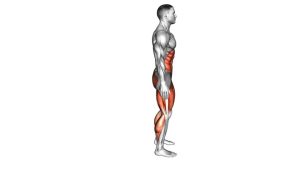
- Stand tall: Place your feet around shoulder-width apart with knees soft and weight balanced through mid-foot.
- Grip the ball securely: Hold the medicine ball with both hands close to the sides so you can control the arc overhead.
- Brace the trunk: Set the ribs down, tighten the core lightly, and avoid flaring the chest.
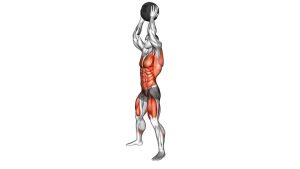
- Raise overhead: Bring the ball high above your head while keeping the shoulders active and the neck neutral.
- Create tension: Reach long through the arms and feel the lats lengthen before initiating the slam.
Tip: A slam ball is usually better than a bouncing medicine ball for this exercise because it is built to absorb repeated impact.
Execution (Step-by-Step)
- Reach tall overhead: Start from a strong, extended position without leaning excessively into the lower back.
- Initiate the pull: Drive the ball down by aggressively pulling through the lats and upper body.
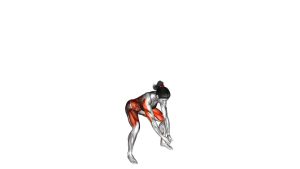
- Snap the torso and hips: As the ball comes down, brace hard through the abs and hinge explosively to add force.
- Slam through the floor: Throw the ball down with intent directly in front of your feet, not too far forward.
- Absorb the follow-through: Let the knees and hips bend naturally so the spine stays controlled at the bottom.
- Reset with control: Pick the ball up safely, return to the start, and repeat with the same crisp rhythm.
Pro Tips & Common Mistakes
- Think “pull down,” not just “throw down”: This helps shift more work into the lats and trunk.
- Keep the ribs under control overhead: Avoid turning the top position into a lower-back arch.
- Use the hips, not only the arms: Strong reps blend overhead reach, abdominal brace, and hip-driven force.
- Do not let the ball drift too far forward: A forward slam can pull you out of position and waste power.
- Maintain a clean spine in the follow-through: Flex through the trunk with control instead of collapsing.
- Choose an appropriate load: Heavy enough to challenge power production, light enough to move explosively.
- Common mistake: Catching or chasing a bouncing ball. Use a true slam ball whenever possible.
FAQ
What muscles does the medicine ball overhead slam work most?
The movement strongly involves the lats, abdominals, and obliques, while the shoulders, triceps, glutes, and hamstrings help create and transfer force.
Is this a back exercise or a core exercise?
It is both, but this variation can be coached to feel especially back-focused by emphasizing the overhead reach and the aggressive lat-driven pull into the slam.
Should I use a medicine ball or a slam ball?
A slam ball is usually the better choice because it is designed for repeated floor impact and does not rebound much after the throw.
How heavy should the ball be?
Use a weight that lets you stay explosive. If the movement slows down too much or your form breaks, the ball is probably too heavy for your current goal.
Can beginners do this exercise?
Yes, but many beginners should start with a lighter ball and learn how to brace, hinge, and control the overhead position before trying maximal effort slams.
Recommended Equipment
- Non-Bounce Slam Ball — the main tool for the exercise; built for repeated overhead slams and floor impact
- Mid-Weight Slam Ball (Around 15–20 lb) — a practical range for many intermediate trainees focused on power and conditioning
- Rubber Gym Flooring — helps protect the floor, reduce noise, and create a more stable slam surface
- Workout Gloves — optional grip support for longer conditioning sets or sweaty training sessions
- Heavy-Duty Exercise Mat / Home Gym Mat — useful for home setups where you want additional impact absorption and surface protection
Tip: Prioritize a durable slam ball and a safe surface first. Those two upgrades usually make the biggest difference for performance and equipment longevity.