Barbell Standing Overhead Triceps Extension: Proper Form, Sets, Tips & FAQ
Learn how to do the Barbell Standing Overhead Triceps Extension with proper form. Discover setup tips, step-by-step execution, sets and reps by goal, common mistakes, FAQs, and recommended equipment.
Barbell Standing Overhead Triceps Extension
This exercise is best performed with strict control, a stable core, and a manageable load. It rewards lifters who focus on elbow movement rather than turning the lift into a standing press. Done correctly, it creates a strong contraction at the top and a deep, productive stretch at the bottom.
Quick Overview
| Body Part | Triceps |
|---|---|
| Primary Muscle | Triceps brachii (long head emphasis) |
| Secondary Muscle | Medial head and lateral head of the triceps, anterior delts and core stabilizers |
| Equipment | Barbell |
| Difficulty | Intermediate |
Sets & Reps (By Goal)
- Muscle growth: 3–4 sets × 8–12 reps with controlled tempo and 60–90 seconds rest
- Strength-focused arm work: 4–5 sets × 5–8 reps with heavier load and 90–120 seconds rest
- Technique and joint-friendly control: 2–3 sets × 10–15 reps with moderate weight and smooth form
- Accessory after pressing workouts: 2–4 sets × 8–12 reps without going to technical breakdown
Progression rule: Add reps first, then increase load in small increments once you can keep your elbows stable, your torso upright, and the lowering phase controlled.
Setup / Starting Position
- Stand tall: Place your feet about hip- to shoulder-width apart for a stable base.
- Grip the barbell securely: Use a close to shoulder-width grip that feels comfortable on your wrists and elbows.
- Press the bar overhead: Start with arms extended above your head and elbows pointing mostly forward.
- Brace your core: Keep ribs down, glutes lightly engaged, and avoid excessive arching through the lower back.
- Set the upper arms: Keep them mostly vertical and close to the sides of your head before starting the rep.
Tip: If overhead positioning feels unstable, reduce the load and focus on clean elbow mechanics before trying to go heavier.
Execution (Step-by-Step)
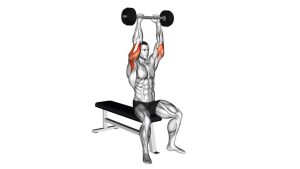
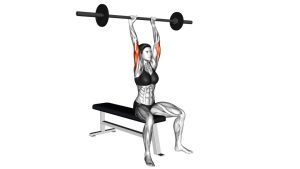
- Begin from lockout: Hold the barbell overhead with elbows extended and shoulders stable.
- Lower under control: Bend at the elbows and bring the barbell down behind your head in a smooth arc.
- Keep upper arms fixed: Avoid letting the elbows flare wide or the shoulders take over the movement.
- Reach the stretched position: Lower until you feel a strong triceps stretch without losing posture or comfort.
- Extend the elbows: Drive the barbell back up by contracting the triceps, returning to full overhead lockout.
- Reset and repeat: Pause briefly at the top, stabilize, and begin the next rep with the same controlled tempo.
Pro Tips & Common Mistakes
- Keep the elbows from drifting too wide: A moderate tuck helps maintain tension on the triceps.
- Don’t rush the lowering phase: The eccentric stretch is one of the most valuable parts of the exercise.
- Avoid leaning back: Excessive spinal extension shifts tension away from the triceps and stresses the lower back.
- Use a realistic range of motion: Go deep enough for a stretch, but not so deep that your shoulders or elbows feel unstable.
- Keep wrists stacked: Don’t let them collapse backward under the barbell.
- Choose load carefully: Too much weight often causes elbow flare, momentum, and loss of isolation.
FAQ
What part of the triceps does this exercise emphasize most?
The overhead position places extra stretch on the long head of the triceps, which is why this variation is commonly used for fuller triceps development.
Is a barbell standing overhead triceps extension better for size or strength?
It is mainly a hypertrophy-focused isolation exercise. It can support strength training, but it is usually best used to build muscle and improve triceps development after compound pressing work.
Should my elbows stay completely still?
They do not need to be perfectly frozen, but they should remain mostly fixed. Too much movement at the shoulder reduces triceps isolation and makes the exercise less efficient.
Can beginners do this exercise?
Beginners can use it, but many do better starting with a lighter barbell, EZ curl bar, or dumbbell version until they can control the overhead position comfortably.
What if I feel elbow discomfort?
Reduce the load, shorten the range slightly, slow down the eccentric, and make sure your elbows are not flaring excessively. If discomfort continues, switch to a more joint-friendly variation.
Recommended Equipment
- Olympic Barbell — the primary tool for performing this exercise with stable loading and progression
- Weight Plates Set — useful for micro-loading and gradually increasing resistance over time
- Barbell Collars — helps secure plates firmly and improves safety during overhead work
- Weightlifting Belt — optional support for lifters who need extra trunk bracing awareness during standing overhead lifts
- EZ Curl Bar — a useful alternative for those who want a more wrist- and elbow-friendly overhead extension setup
Tip: Start with the lightest setup you can control overhead. For many lifters, better stability and elbow comfort lead to better long-term triceps growth than simply using more weight.