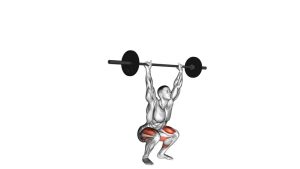
Kettlebell One-Arm Overhead Squat: Form, Benefits, Sets & Tips
Learn the kettlebell one-arm overhead squat for legs, core, shoulder stability, mobility, balance, proper form, mistakes, FAQs, and equipment.
Kettlebell One-Arm Overhead Squat
This exercise is best used by lifters who already have a strong squat pattern, stable overhead position, and enough ankle, hip, and thoracic mobility to keep the torso controlled. Because the load is held on one side, the body must resist rotation, side bending, and forward collapse. This makes the movement highly effective for developing functional strength, balance, posture control, and total-body coordination.
Quick Overview
| Body Part | Legs |
|---|---|
| Primary Muscle | Quadriceps, glutes, and shoulders |
| Secondary Muscle | Core, obliques, upper back, hamstrings, calves, rotator cuff, and spinal stabilizers |
| Equipment | Kettlebell |
| Difficulty | Advanced |
Sets & Reps (By Goal)
- Technique practice: 3–5 sets × 2–4 reps per side using a very light kettlebell.
- Strength and stability: 3–4 sets × 4–6 reps per side with controlled tempo.
- Mobility and control: 2–4 sets × 3–5 slow reps per side with a 2–3 second bottom pause.
- Conditioning skill work: 3–5 rounds × 5 reps per side, only if form stays stable.
Progression rule: Improve control before increasing weight. Add load only when the kettlebell stays stacked overhead, the heels stay planted, and both sides move with the same quality.
Setup / Starting Position
- Clean or press the kettlebell overhead: Lock one kettlebell out above the shoulder with the wrist neutral and elbow fully extended.
- Set your feet: Stand around shoulder-width apart, with toes slightly turned out if needed for squat depth.
- Stack the load: Keep the kettlebell aligned over the shoulder, ribs, hips, and mid-foot.
- Brace your core: Tighten the abs and obliques to prevent leaning away from the kettlebell.
- Use the free arm naturally: Let the non-working arm move slightly for balance without twisting the torso.
- Look forward: Keep the head neutral and chest lifted before starting the descent.
Tip: If the kettlebell drifts forward before you squat, reduce the weight and practice the overhead lockout first.
Execution (Step-by-Step)
- Lock the shoulder: Press the kettlebell upward and keep the shoulder active, not loose or shrugged aggressively.
- Begin the squat: Bend the knees and hips together while keeping the kettlebell stacked over your center of balance.
- Control the descent: Lower slowly with the chest lifted, knees tracking in line with the toes, and heels planted.
- Reach full depth: Descend as far as you can while maintaining a neutral spine and stable overhead arm.
- Pause briefly: Hold the bottom position for a moment without bouncing or letting the kettlebell drift.
- Drive upward: Push through the mid-foot and heel while keeping the hips and shoulders rising together.
- Finish tall: Stand fully upright with the knees and hips extended and the kettlebell still locked out overhead.
- Repeat or switch sides: Complete all reps with control, then safely lower the kettlebell and repeat on the opposite arm.
Pro Tips & Common Mistakes
- Keep the kettlebell stacked: The wrist, elbow, shoulder, ribs, hips, and mid-foot should stay close to one vertical line.
- Do not rush the descent: A slow lowering phase builds better balance, strength, and positional awareness.
- Avoid rib flare: Keep the ribs down so the lower back does not overarch under the overhead load.
- Do not let the knees collapse inward: Track the knees in the same direction as the toes.
- Use a light kettlebell first: This exercise is limited by mobility and stability, not just leg strength.
- Do not twist toward the kettlebell: Keep the chest square and resist rotation through the core.
- Maintain a strong lockout: A soft elbow can make the kettlebell unstable and increase shoulder stress.
- Earn your depth: Squat only as deep as you can while keeping the heel down, spine neutral, and arm stable.
FAQ
Is the kettlebell one-arm overhead squat beginner-friendly?
No. This is usually an advanced exercise because it requires strong squat mechanics, shoulder stability, core control, and overhead mobility. Beginners should start with bodyweight squats, goblet squats, and overhead holds before attempting this variation.
What muscles does the kettlebell one-arm overhead squat work?
It primarily works the quads, glutes, shoulders, and core. It also trains the obliques, upper back, rotator cuff, hamstrings, calves, and spinal stabilizers because the body must control an uneven overhead load.
Why does the kettlebell drift forward during the squat?
Forward drift usually happens because of limited shoulder mobility, poor thoracic extension, weak overhead stability, or lack of core bracing. Use a lighter kettlebell and practice keeping the arm vertical before increasing depth or load.
How deep should I squat?
Squat as deep as you can while keeping the heels planted, knees controlled, spine neutral, and kettlebell stable overhead. Full depth is useful, but clean alignment is more important than forcing range.
Can this exercise improve mobility?
Yes. It can help improve usable mobility in the ankles, hips, thoracic spine, and shoulders. However, it should not be used to force mobility. Use light weight and controlled reps to build strength in safe ranges.
Should I use one kettlebell or two?
Start with one kettlebell. The single-arm version teaches balance, anti-rotation, and shoulder control. Two-kettlebell overhead squats are more demanding and should only be used after mastering the single-arm variation.
Recommended Equipment
- Cast Iron Kettlebell — ideal for practicing the one-arm overhead squat with progressive loading.
- Competition Kettlebell — consistent size across weights, useful for clean overhead technique and balanced practice.
- Kettlebell Wrist Guards — helps reduce wrist discomfort during overhead kettlebell work.
- Weightlifting Shoes — raised heel can support better squat depth and upright torso positioning.
- Mobility Resistance Bands — useful for shoulder, hip, and ankle mobility warm-ups before overhead squats.
Tip: Choose a kettlebell that allows perfect control. For this movement, stability and alignment matter more than heavy loading.