Roll Press Plank: Core, Shoulder Stability, Form, Sets & FAQ
Learn the Roll Press Plank to build core control, shoulder stability, and plank strength with step-by-step form, sets, tips, FAQ, and gear.
Roll Press Plank
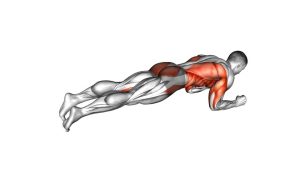
This exercise works best when the movement stays small, steady, and controlled. Your elbows remain on the floor while your shoulders glide forward and backward. Meanwhile, your core must resist hip sagging, lower-back arching, and side-to-side twisting. As a result, the Roll Press Plank becomes a powerful drill for building stronger planks, better shoulder control, and cleaner bodyweight strength.
Quick Overview
| Body Part | Core |
|---|---|
| Primary Muscle | Rectus abdominis, transverse abdominis, and deep core stabilizers |
| Secondary Muscle | Shoulders, chest, triceps, serratus anterior, glutes, quads |
| Equipment | No equipment required; exercise mat optional |
| Difficulty | Intermediate because it requires plank strength, shoulder control, and steady core tension |
Sets & Reps (By Goal)
- Core control: 2–3 sets × 6–10 slow reps with 45–60 seconds rest.
- Shoulder stability: 3–4 sets × 8–12 controlled reps with 60–75 seconds rest.
- Strength endurance: 2–4 sets × 20–40 seconds with smooth continuous motion.
- Warm-up activation: 1–2 sets × 5–8 easy reps before push-ups, planks, or upper-body training.
Progression rule: Add reps first, then add time under tension. However, do not increase range if your hips drop or your shoulders lose control.
Setup / Starting Position
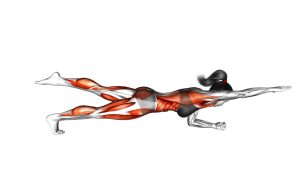
- Start on the floor: Place your forearms on the ground with elbows bent and close to shoulder width.
- Set your plank line: Extend both legs back and balance on your toes.
- Stack your posture: Keep your head, ribs, hips, knees, and heels in one long line.
- Brace your core: Tighten your abs as if preparing for a light punch.
- Lock in the lower body: Squeeze your glutes and keep your thighs active to reduce hip sagging.
- Keep the neck neutral: Look slightly down, not forward, so your neck stays aligned with your spine.
Setup tip: If the floor feels uncomfortable on your elbows, use a firm exercise mat. However, avoid a surface that is too soft because it can reduce stability.
Execution (Step-by-Step)
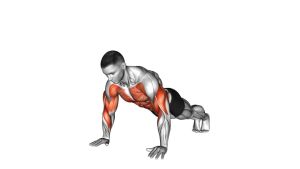
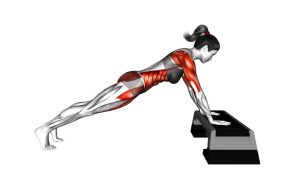
- Begin in a strong forearm plank: Press your forearms into the floor and keep your body straight.
- Roll the body slightly forward: Shift your shoulders ahead of your elbows while staying on your toes.
- Control the chest position: Let the chest move slightly forward without collapsing toward the floor.
- Keep the hips stable: Resist sagging, piking, or rotating as the shoulders glide forward.
- Press back through the forearms: Push the floor away and return your shoulders over the elbows.
- Reset your plank line: Finish each rep with your ribs down, glutes tight, and neck neutral.
- Repeat smoothly: Move with a steady rhythm while keeping the range controlled.
Pro Tips & Common Mistakes
- Use your forearms actively: Press the floor away instead of sinking into your shoulders.
- Keep the movement small: A short, clean roll is better than a large, sloppy shift.
- Brace before moving: Set your abs first, then roll forward.
- Avoid hip sagging: If your lower back drops, squeeze your glutes harder and reduce range.
- Do not rush: Fast reps usually reduce core tension and shoulder control.
- Keep elbows grounded: This is a forearm-based plank movement, not a push-up.
- Avoid shrugging: Keep the neck long and the shoulders controlled.
- Breathe steadily: Exhale lightly as you press back, and avoid holding your breath for the whole set.
FAQ
What muscles does the Roll Press Plank work?
The Roll Press Plank mainly works the core, especially the abs and deep stabilizers. In addition, it trains the shoulders, chest, triceps, serratus anterior, glutes, and quads because the body must stay rigid during the forward-and-back motion.
Is the Roll Press Plank good for beginners?
It can be challenging for complete beginners. Therefore, start with a regular forearm plank first. Once you can hold a clean plank for 20–30 seconds, add a small forward-and-back roll.
Should my elbows move during the exercise?
Your elbows should stay planted on the floor. The movement comes from your shoulders and body shifting slightly forward and then pressing back.
Why do I feel this in my shoulders?
That is normal because the shoulders help control the forward roll and press-back phase. However, sharp pain or pinching is not normal. Reduce the range, check elbow position, and stop if discomfort continues.
How do I make the Roll Press Plank easier?
Shorten the range, slow down, or perform a regular forearm plank first. You can also place your feet slightly wider to improve balance.
How do I make it harder?
Increase time under tension, slow each rep, pause briefly in the forward position, or narrow your foot stance. However, only progress when your hips and ribs stay controlled.
Recommended Equipment (Optional)
- Extra Thick Exercise Mat — helps cushion the elbows during forearm plank work.
- Forearm Plank Pads — useful if elbow pressure limits your plank comfort.
- Resistance Bands Set — helpful for pairing the exercise with shoulder and upper-back activation.
- Core Sliders — optional tool for advanced plank progressions and controlled body glides.
- Foam Roller — useful for warm-up mobility before core and shoulder training.
Tip: Equipment is optional. The main priority is a stable surface, clean plank alignment, and controlled shoulder movement.