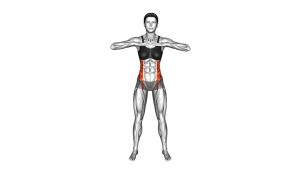
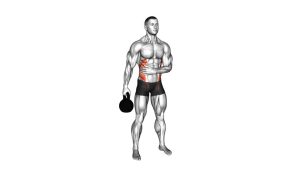
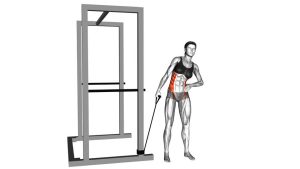
Standing Twist Turn Lift: Core Rotation Form, Benefits, Sets & Tips
Learn the Standing Twist Turn Lift to train obliques, core rotation, shoulder control, and full-body coordination with safe form tips.
Standing Twist Turn Lift
This exercise is useful for building rotational strength, improving full-body coordination, and training the core to transfer force between the lower body and upper body. It works best when the movement is smooth, controlled, and led by the torso rather than pulled only with the arms.
Quick Overview
| Body Part | Core |
|---|---|
| Primary Muscle | Obliques |
| Secondary Muscle | Rectus abdominis, transverse abdominis, shoulders, glutes, upper back |
| Equipment | Dumbbell, medicine ball, weight plate, kettlebell, or no weight for beginners |
| Difficulty | Beginner to Intermediate |
Sets & Reps (By Goal)
- Technique practice: 2–3 sets × 8–10 reps per side with light resistance.
- Core strength: 3–4 sets × 10–12 reps per side with controlled tempo.
- Functional conditioning: 3–5 sets × 12–15 reps per side using a smooth rhythm.
- Warm-up activation: 1–2 sets × 8 reps per side using bodyweight or a very light load.
Progression rule: Master the diagonal path first. Then increase reps, slow down the lowering phase, or use a slightly heavier weight. Do not progress if your spine twists aggressively or your arms start swinging.
Setup / Starting Position
- Stand tall: Place your feet about shoulder-width apart with knees slightly soft.
- Hold the weight: Grip a dumbbell, medicine ball, plate, or kettlebell with both hands.
- Brace the core: Keep ribs stacked over hips and avoid arching the lower back.
- Set the shoulders: Keep shoulders down and back without shrugging.
- Choose your diagonal: Start with the weight low on one side or centered in front of the body depending on the variation.
Tip: Beginners should begin with a light medicine ball or no weight until the rotation feels smooth and balanced.
Execution (Step-by-Step)
- Brace before moving: Inhale gently and create light abdominal tension.
- Rotate toward one side: Turn the torso while keeping the hips controlled and feet grounded.
- Guide the weight diagonally: Move the weight from a lower position toward the opposite upper side.
- Lift with control: Let the core, hips, and shoulders work together instead of yanking with the arms.
- Pause briefly at the top: Keep the ribs down and avoid leaning backward.
- Return slowly: Reverse the diagonal path back to the starting side.
- Repeat evenly: Complete all reps on one side, then switch sides.
Pro Tips & Common Mistakes
- Use the core first: The arms should guide the weight, but the torso should control the movement.
- Avoid over-rotating: Rotate only as far as you can maintain balance and spinal control.
- Keep the ribs down: Do not lean back at the top of the lift.
- Control the lowering phase: The return should be slow enough to feel the obliques working.
- Do not lock the knees: Soft knees help the hips and core absorb rotation safely.
- Start light: Heavy weight can quickly turn this into a momentum-based movement.
- Match both sides: Train left and right evenly to improve balanced rotational strength.
FAQ
What muscles does the Standing Twist Turn Lift work?
It primarily works the obliques and deep core stabilizers. It also involves the shoulders, glutes, upper back, and hips because the movement uses a full-body diagonal rotation pattern.
Is the Standing Twist Turn Lift good for abs?
Yes. It is especially useful for training the abs through rotation and anti-rotation control. It targets the sides of the waist more than basic crunches and teaches the core to control movement in a standing position.
Should I use a dumbbell or medicine ball?
Both can work. A medicine ball is often easier for beginners because it is simple to hold with two hands. A dumbbell or kettlebell can be used once you can control the diagonal path without swinging.
How heavy should the weight be?
Start light. Choose a weight that lets you complete every rep with clean rotation, steady balance, and no lower-back strain. If your arms swing or your spine twists aggressively, the weight is too heavy.
Can beginners do this exercise?
Yes, beginners can do it with no weight or a very light medicine ball. The main priority is learning how to rotate, turn, and lift smoothly before adding load.
What is the biggest mistake with this exercise?
The biggest mistake is using momentum. The exercise should be controlled by the core and torso, not thrown by the arms. Slow down and reduce weight if you cannot keep the movement stable.
Recommended Equipment
- Medicine Ball — great for learning the movement with a comfortable two-hand grip.
- Rubber-Coated Dumbbell — useful for progressive loading once your core control improves.
- Weight Plate with Handles — provides a secure grip for diagonal lifting and rotational core drills.
- Kettlebell — adds a compact load option for standing rotational movements.
- Non-Slip Exercise Mat — improves foot stability during standing core exercises.
Tip: Choose equipment that allows a secure two-hand grip. Better control usually gives better core activation than using a heavy load.