90-Degree Heel Touch Against Wall: Safe Form, Sets, Tips & FAQ
Learn the 90-Degree Heel Touch Against Wall to train abs with wall-supported control. Includes form, sets, mistakes, FAQs, and equipment.
90-Degree Heel Touch Against Wall
This exercise is useful when you want a simple bodyweight ab movement that limits leg momentum and keeps the focus on controlled spinal flexion. The wall gives the feet a stable contact point, which makes it easier to maintain a fixed lower-body position while the upper body curls toward the heels.
The goal is not to sit all the way up. The goal is to lift the head, shoulders, and upper back just enough to shorten the abs, reach toward the heels, pause briefly, and lower with control. A clean repetition should feel smooth, compact, and abdominal-focused.
Quick Overview
| Body Part | Core |
|---|---|
| Primary Muscle | Rectus abdominis |
| Secondary Muscle | Obliques, deep core stabilizers, hip flexors assisting lightly as stabilizers |
| Equipment | Wall and exercise mat |
| Difficulty | Beginner to intermediate, depending on tempo and hold time |
Sets & Reps (By Goal)
- Beginner core control: 2–3 sets × 8–12 reps, using a slow and comfortable range.
- Ab endurance: 3–4 sets × 12–20 reps, keeping tension without rushing.
- Strict ab activation: 3 sets × 8–12 reps with a 1–2 second squeeze at the top.
- Warm-up or finisher: 1–2 sets × 10–15 reps with light effort and clean breathing.
Progression rule: First improve control, then increase reps, then add a longer top hold. Do not progress by swinging the arms or forcing the neck forward.
Setup / Starting Position
- Lie on your back: Position yourself on an exercise mat with your hips close enough to a wall so your feet can press into it.
- Set the legs: Bend your hips and knees to about 90 degrees, placing both feet flat against the wall.
- Brace the core: Gently tighten your abs and keep your lower back controlled against the floor without excessive arching.
- Place the arms: Reach both arms forward toward your heels or ankles.
- Set the neck: Keep your chin slightly tucked and your eyes forward/upward instead of pulling the head aggressively.
The wall should support your foot position, not create a hard pushing contest. Press just enough to keep the legs steady.
Execution (Step-by-Step)
- Start with tension: Keep your feet planted on the wall and lightly brace your abs before moving.
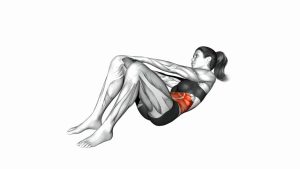
- Curl upward: Lift your head, shoulders, and upper back from the floor as your hands reach toward your heels.
- Shorten the abs: Think about bringing your ribs toward your pelvis rather than simply reaching with your arms.
- Pause briefly: Hold the top position for a moment while keeping the neck relaxed and the feet stable.
- Lower slowly: Return toward the floor under control without dropping completely or losing abdominal tension.
- Repeat smoothly: Continue each rep with a steady rhythm and no bouncing.
Pro Tips & Common Mistakes
- Keep the range compact: A small, controlled crunch is better than a large, sloppy sit-up.
- Reach from the ribs, not the neck: Let the abs lift the torso while the arms simply guide the direction.
- Do not pull the head: Keep the neck neutral and avoid jamming the chin into the chest.
- Keep both feet on the wall: If your feet slide or lift, slow down and reduce the range of motion.
- Avoid momentum: Do not bounce off the floor or swing the arms to complete the rep.
- Control the lowering phase: The eccentric portion builds control, so lower slowly instead of collapsing.
- Breathe properly: Exhale as you crunch up and inhale as you lower back down.
FAQ
What muscles does the 90-Degree Heel Touch Against Wall work?
It primarily works the rectus abdominis, which is the main front abdominal muscle. The obliques and deeper core muscles help stabilize the torso, while the hip flexors assist lightly in maintaining leg position.
Is this exercise beginner-friendly?
Yes. It is beginner-friendly because the wall helps stabilize the lower body. However, beginners should use a short range of motion and avoid pulling the neck forward.
Should my lower back stay flat on the floor?
Your lower back should stay controlled and comfortable. A gentle abdominal brace helps reduce excessive arching, but you should not force the spine aggressively into the floor.
Why use the wall instead of keeping the feet in the air?
The wall gives the feet a stable contact point. This reduces lower-body movement and makes it easier to focus on the abdominal crunch pattern.
Is this the same as a regular heel touch?
No. A regular heel touch is often performed with the feet on the floor and includes more side-to-side oblique movement. This wall-supported version uses a 90-degree leg position and focuses more on a controlled crunch toward the heels.
How can I make it harder?
Slow the tempo, add a 2–3 second top hold, increase reps, or keep the shoulder blades slightly lifted between reps. Avoid adding difficulty by swinging or forcing the neck.
Recommended Equipment
- Exercise Mat — provides cushioning for the spine, hips, and shoulders during floor-based ab work.
- Thick Yoga Mat — useful if you need extra comfort on hard floors.
- Ab Workout Mat — supports repeated crunch-style movements with better comfort.
- Non-Slip Exercise Mat — helps keep your body stable while your feet press against the wall.
- Small Fitness Towel — can be used under the head or upper back for light comfort if needed.
Tip: Choose equipment that improves comfort without changing the exercise mechanics. The wall, mat, and controlled body position are the main requirements.