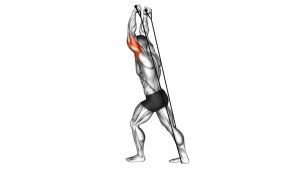
Band Cross Chest Biceps Curl: Proper Form, Sets, Tips & FAQ
Learn the Band Cross Chest Biceps Curl for stronger biceps, better peak contraction, and improved arm control. Includes proper form, setup, sets by goal, common mistakes, FAQs, and recommended equipment.
Band Cross Chest Biceps Curl
This variation works especially well when you want a strong biceps contraction without heavy joint stress. Because the resistance band increases tension as it stretches, the top half of the curl feels especially challenging. The key is to move with control, keep the working elbow stable, and avoid turning the rep into a shoulder-driven swing.
Quick Overview
| Body Part | Biceps |
|---|---|
| Primary Muscle | Biceps brachii |
| Secondary Muscle | Brachialis, brachioradialis, forearm stabilizers, anterior shoulder stabilizers |
| Equipment | Resistance band |
| Difficulty | Beginner to Intermediate |
Sets & Reps (By Goal)
- Muscle growth: 3–4 sets × 10–15 reps per arm, 45–75 sec rest
- Strength-focused control: 3–5 sets × 6–10 reps per arm with a stronger band, 60–90 sec rest
- Toning / general fitness: 2–4 sets × 12–20 reps per arm, 30–60 sec rest
- Warm-up / activation: 1–2 sets × 12–15 smooth reps per arm with light tension
Progression rule: Add reps first, then increase band tension, then slow the eccentric phase or add a pause at the top.
Setup / Starting Position
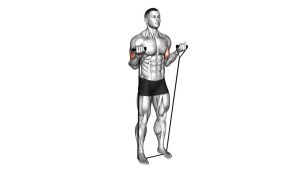
- Anchor the band: Step on one end of the resistance band with the same-side foot or position it securely under your foot for stable tension.
- Stand tall: Keep your chest up, ribs stacked, and core lightly braced without leaning backward.
- Grip the band: Hold the free end in one hand with the arm extended down and slightly in front of the body.
- Set the shoulder: Keep the shoulder relaxed and down, not shrugged up toward the ear.
- Prepare the path: The hand will travel diagonally across the torso toward the opposite side of the chest.
Tip: Stand far enough on the band to create tension at the bottom, but not so much that you lose smooth control at the top.
Execution (Step-by-Step)
- Start from full extension: Begin with the working arm down, elbow close to your side, and wrist neutral.
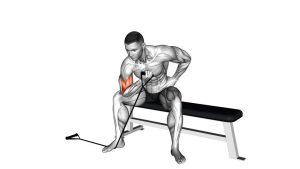
- Curl across the body: Pull the band upward and diagonally across your torso toward the opposite side of your chest.
- Keep the elbow controlled: Let the elbow bend naturally, but avoid excessive forward drift or shoulder takeover.
- Squeeze at the top: Pause briefly when the hand reaches chest level and focus on contracting the biceps.
- Lower slowly: Return the arm along the same diagonal path until you reach full extension under control.
- Repeat evenly: Complete all reps on one arm or alternate sides while maintaining the same tempo and form.
Pro Tips & Common Mistakes
- Keep the torso quiet: Avoid leaning, twisting, or swinging to complete the rep.
- Use the diagonal path intentionally: Bring the hand across the chest, but do not let it turn into a shoulder raise.
- Control the eccentric: Lowering slowly helps keep tension on the biceps and improves results.
- Don’t overgrip: Squeezing the handle too hard can create unnecessary forearm fatigue.
- Keep the wrist neutral: Don’t curl the wrist upward to cheat the top of the rep.
- Choose the right band: Too much resistance often causes shortened range and poor mechanics.
- Pause at peak contraction: A short squeeze at the top can improve mind-muscle connection.
FAQ
What does the Band Cross Chest Biceps Curl target?
It mainly targets the biceps brachii, while also involving the brachialis, brachioradialis, and small stabilizers in the forearm and shoulder.
Is this better than a regular band curl?
It is not necessarily better for everyone, but it offers a different stimulus. The cross-chest path can improve peak contraction and unilateral control, making it a useful variation alongside standard curls.
Should I train one arm at a time?
Yes, this exercise is commonly performed one arm at a time. That makes it easier to focus on the diagonal path, reduce momentum, and correct side-to-side strength differences.
How heavy should the band be?
Use a band that allows you to complete the full range with good control. If you cannot pause at the top or lower slowly, the resistance is probably too heavy.
Can beginners use this exercise?
Yes. Beginners can benefit from this movement as long as they use light-to-moderate band tension and focus on technique before trying to increase resistance.
Recommended Equipment
- Resistance Bands Set — ideal for adjusting resistance levels as you progress
- Single Band Handle Attachments — improves grip comfort and control during unilateral curls
- Workout Gloves — can reduce grip discomfort and help maintain control
- Non-Slip Exercise Mat — provides a stable surface for secure band foot anchoring
- Home Gym Mirror — useful for checking elbow position, posture, and torso control
Tip: For this exercise, the most important equipment choice is a band with appropriate tension. Smooth control is more valuable than using the heaviest band possible.