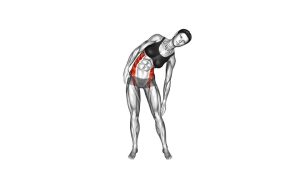
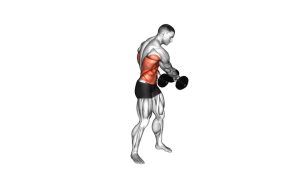
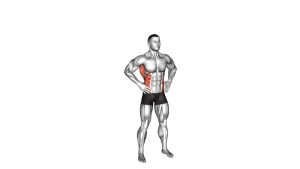
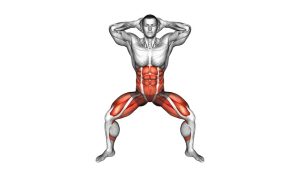
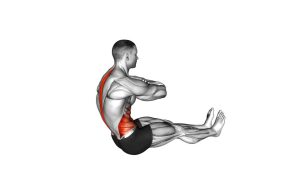
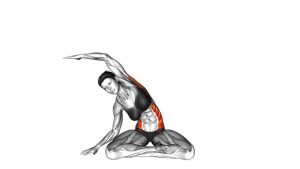
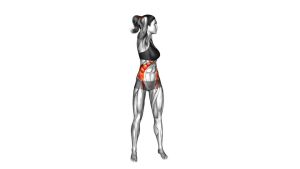
Stick Standing Twist Stretch: Form, Benefits, Tips & FAQ
Learn the Stick Standing Twist Stretch to improve torso rotation, oblique mobility, and posture control with safe setup, form tips, sets, FAQs, and gear.
Stick Standing Twist Stretch
This exercise is best performed with a slow and controlled tempo. Instead of forcing a deep twist, rotate only as far as you can while keeping your feet planted, your spine upright, and your hips mostly forward. As a result, the drill works well as a warm-up before core training, upper-body sessions, sports practice, or any workout that benefits from smoother trunk rotation.
Quick Overview
| Body Part | Core |
|---|---|
| Primary Muscle | Obliques |
| Secondary Muscle | Thoracic spine stabilizers, erector spinae, shoulders, and deep core stabilizers |
| Equipment | Stick, dowel, broomstick, or light mobility bar |
| Difficulty | Beginner |
Sets & Reps (By Goal)
- General mobility: 2–3 sets × 10–16 total twists with a smooth tempo
- Warm-up preparation: 1–2 sets × 8–12 total twists before training
- Posture and rotation control: 2–4 sets × 6–10 slow reps per side
- Stretch-focused practice: 2–3 sets × 20–30 seconds of alternating rotations
Progression rule: First improve smoothness and control. Then, gradually increase range of motion only if your hips stay stable and your spine stays tall.
Setup / Starting Position
- Stand tall: Place your feet about hip-width apart and keep your weight balanced evenly.
- Position the stick: Rest the stick across your upper back, behind the neck and shoulders.
- Grip wide: Hold the stick with both hands wider than shoulder width so the shoulders stay open.
- Stack your posture: Keep your chest lifted, ribs controlled, and head neutral.
- Brace lightly: Engage your core just enough to avoid leaning or arching during the twist.
The stick should guide your shoulder line. However, it should not be pulled hard into your neck or forced downward.
Execution (Step-by-Step)
- Begin from center: Stand upright with the stick level across your shoulders.
- Rotate to one side: Turn your shoulders and upper torso slowly while keeping your feet planted.
- Control the end range: Pause briefly when you reach a comfortable twist without bouncing.
- Return to neutral: Rotate back to the center with the same controlled speed.
- Repeat on the opposite side: Turn smoothly in the other direction while keeping the stick horizontal.
- Continue alternating: Move side to side with steady breathing and consistent posture.
Pro Tips & Common Mistakes
- Keep the stick level: If one side drops, slow down and reduce the range.
- Rotate from the torso: Let the shoulders and trunk turn together rather than twisting only the arms.
- Avoid bouncing: Use a smooth stretch instead of quick, jerky rotations.
- Keep the hips mostly forward: Some natural movement may happen, but do not pivot aggressively.
- Stand tall throughout: Avoid collapsing the chest or leaning backward during the twist.
- Use relaxed breathing: Exhale gently as you rotate, then inhale as you return to center.
- Do not force range: A smaller clean twist is better than a larger twist with compensation.
FAQ
What is the Stick Standing Twist Stretch good for?
It is useful for improving controlled torso rotation, warming up the core, and practicing better shoulder alignment during twisting movements. Additionally, it can help prepare the body for workouts that involve rotation.
Where should I feel this exercise?
You may feel a light stretch through the sides of the waist, obliques, upper back, and torso. However, you should not feel sharp pain in the lower back or neck.
Should my hips move during the stretch?
Your hips should stay mostly forward and stable. Although a small amount of natural movement may happen, the main rotation should come from the torso and shoulders.
Can beginners do the Stick Standing Twist Stretch?
Yes. This is a beginner-friendly mobility drill when performed slowly. Start with a smaller range of motion, then increase the twist only when your movement feels smooth and pain-free.
Is this a strength exercise or a stretch?
It is mainly a mobility and stretch exercise. Even so, the core muscles stay lightly active because they help control posture, rotation, and balance.
Recommended Equipment
- Wooden Exercise Dowel — simple tool for standing twists, shoulder mobility, and posture drills
- Mobility Stick — useful for controlled rotation, warm-ups, and flexibility training
- Pilates Bar Stick — lightweight option for mobility drills and low-impact exercise routines
- Non-Slip Exercise Mat — provides stable foot placement during standing mobility work
- Resistance Bands Set — helpful for pairing torso mobility with upper-back and posture exercises
Tip: Choose a stick that is light, straight, and long enough to hold comfortably behind your shoulders.