Band Bicycle Crunch: Form, Core Benefits, Sets, Tips & FAQ
Learn the Band Bicycle Crunch for stronger abs, obliques, and core control. Includes setup, step-by-step form, sets, mistakes, FAQs, and gear.
Band Bicycle Crunch
This exercise is useful when you want a harder version of the standard bicycle crunch without adding heavy external loading. In addition, the band creates constant tension, so your core must stay active through both the knee-drive phase and the leg-extension phase.
Quick Overview
| Body Part | Core |
|---|---|
| Primary Muscle | Rectus abdominis and obliques |
| Secondary Muscle | Hip flexors, transverse abdominis, and deep core stabilizers |
| Equipment | Resistance band and secure anchor point |
| Difficulty | Intermediate |
Sets & Reps (By Goal)
- Core control: 2–3 sets × 8–10 reps per side with slow, clean rotation.
- Muscle endurance: 3–4 sets × 12–16 total alternating reps with steady breathing.
- Oblique focus: 3 sets × 8–12 reps per side with a brief squeeze near the top.
- Conditioning finisher: 2–3 rounds × 20–30 seconds, only if form stays controlled.
Progression rule: First improve control and range. Then, gradually use a stronger band or increase reps.
Setup / Starting Position
- Anchor a resistance band to a low, secure point in front of your feet.
- Lie on your back and place the band around both feet.
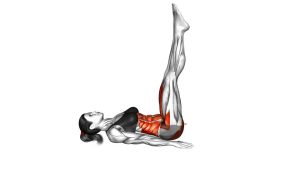
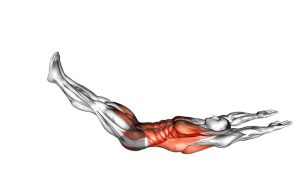
- Extend both legs forward while keeping light band tension.
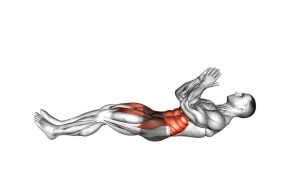
- Place your hands behind your head with elbows wide.
- Brace your core, slightly lift the shoulders, and keep the lower back controlled against the floor.
Start with a light band. Otherwise, the band may pull your legs too aggressively and reduce abdominal control.
Execution (Step-by-Step)
- Brace first: Tighten your abs gently before moving the legs.
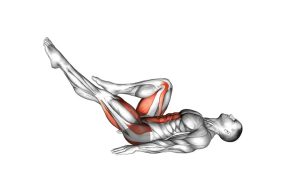
- Drive one knee in: Pull one knee toward your torso while the opposite leg extends forward.
- Rotate the torso: Turn your upper body slightly toward the bent knee without pulling the head.
- Control the band: Keep the extended leg stable as the band creates resistance.
- Switch sides: Alternate smoothly, bringing the opposite knee in as the first leg extends.
- Keep rhythm steady: Move with control rather than speed, and breathe through each rep.
Pro Tips & Common Mistakes
- Keep elbows wide: Do not yank the head forward with your hands.
- Use controlled rotation: Rotate from the ribs and trunk, not from the neck.
- Maintain band tension: Avoid letting the band go slack between reps.
- Control the extended leg: Do not let the band snap the foot back.
- Protect the lower back: Keep the core braced and avoid excessive arching.
- Avoid rushing: Fast reps usually reduce oblique tension and increase hip-flexor dominance.
FAQ
What muscles does the Band Bicycle Crunch work?
It mainly targets the abs and obliques. However, the hip flexors and deep core stabilizers also assist because the legs move against band tension.
Is the Band Bicycle Crunch harder than a regular bicycle crunch?
Yes. The resistance band adds tension to the leg movement, so your core must work harder to stabilize the pelvis and control each alternating rep.
Should my elbow touch my knee?
It is not required. Instead, focus on rotating the torso toward the bent knee while keeping the neck relaxed and the movement controlled.
Why do I feel this exercise in my hip flexors?
Some hip-flexor involvement is normal because the legs are moving. Nevertheless, if the hip flexors dominate, reduce band tension and focus more on abdominal bracing.
Can beginners do this exercise?
Beginners can try it with a very light band, but a standard bicycle crunch or dead bug may be better first if core control is limited.
Recommended Equipment
- Resistance Bands with Door Anchor — useful for safely anchoring the band during floor-based core exercises.
- Loop Resistance Bands — helpful for lighter resistance and controlled beginner progressions.
- Thick Exercise Mat — adds comfort for the spine, hips, and shoulders during supine crunch work.
- Ankle Straps for Resistance Bands — improves band placement and comfort when training leg-driven core movements.
- Ab Workout Mat — provides extra support for repeated crunch variations and floor core sessions.
Choose equipment that lets you move smoothly. In this exercise, control is more important than heavy resistance.