Standing Twist Stretch: Form, Benefits, Sets, Tips & FAQ
Learn the Standing Twist Stretch to improve oblique mobility, thoracic rotation, and core control with safe form, sets, tips, FAQs, and gear.
Standing Twist Stretch
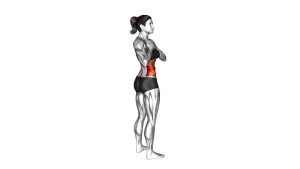
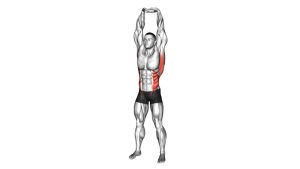
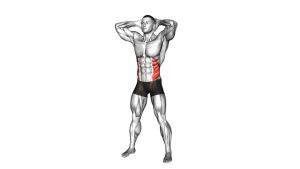
This exercise is useful as a warm-up drill, a mobility reset, or a light core-focused movement before strength training, sports practice, or daily stretching. Because the body stays upright, it is easy to control the range of motion and feel the stretch through the side waist, upper back, and trunk rotation muscles.
Quick Overview
| Body Part | Core |
|---|---|
| Primary Muscle | Obliques |
| Secondary Muscle | Thoracic spine stabilizers, rectus abdominis, lower back stabilizers, shoulders |
| Equipment | None |
| Difficulty | Beginner |
Sets & Reps (By Goal)
- General warm-up: 2–3 sets × 10–16 total rotations with a smooth, relaxed tempo.
- Mobility improvement: 2–4 sets × 8–12 reps per side with a short pause at end range.
- Desk-break posture reset: 1–2 sets × 8–10 reps per side using easy effort.
- Core control practice: 3 sets × 10 reps per side with slower rotation and stable hips.
Progression rule: Improve control before increasing speed or range. A cleaner, slower twist is usually more effective than a large, rushed rotation.
Setup / Starting Position
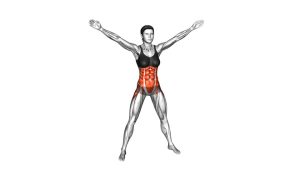
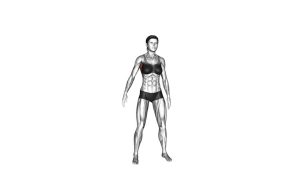
- Stand tall: Place your feet about hip-width to shoulder-width apart for balance.
- Lift the chest: Keep your spine long, ribs stacked, and head aligned over your shoulders.
- Raise the arms: Extend both arms out to the sides at shoulder height, forming a controlled “T” shape.
- Relax the shoulders: Keep the neck soft and avoid shrugging as the arms stay lifted.
- Brace lightly: Engage your core just enough to control the rotation without stiffening the whole body.
Tip: Keep your feet planted and let the rotation come mainly from the torso and upper back, not from spinning the hips.
Execution (Step-by-Step)
- Begin in the tall standing position: Arms extended, chest open, and gaze forward.
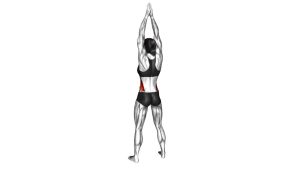
- Rotate to one side: Turn your torso slowly while keeping your arms moving as one unit with your shoulders.
- Keep the hips steady: Allow only a small natural hip shift, but avoid turning the whole lower body aggressively.
- Reach a comfortable end range: Feel a gentle stretch through the obliques, waist, and upper back.
- Return to center: Untwist with control and bring your chest back to the starting position.
- Rotate to the opposite side: Repeat the same smooth motion while keeping both feet grounded.
- Continue alternating: Move left and right in a calm rhythm without using momentum.
Pro Tips & Common Mistakes
- Keep the spine tall: Avoid rounding forward or leaning backward during the twist.
- Rotate through the torso: Do not simply flap the arms side to side without moving the rib cage.
- Avoid over-twisting the lower back: Keep the pelvis controlled and let the upper back share the movement.
- Do not bounce: Hold the end range briefly or return smoothly instead of forcing extra rotation.
- Control your breathing: Exhale gently as you rotate and inhale as you return to center.
- Keep the shoulders relaxed: The arms stay lifted, but the traps should not take over.
- Use it before rotational training: This drill works well before core workouts, sports drills, kettlebell work, or mobility sessions.
FAQ
What muscles does the Standing Twist Stretch work?
The Standing Twist Stretch mainly targets the obliques while also involving the thoracic spine, upper back, shoulders, and light core stabilizers.
Is the Standing Twist Stretch good for beginners?
Yes. It is beginner-friendly because it requires no equipment, uses a simple standing position, and allows you to control the range of motion easily.
Should my hips move during the twist?
A small natural movement is fine, but the main rotation should come from the torso. Avoid spinning the hips aggressively because that reduces the focus on core and thoracic mobility.
Can I use this exercise as a warm-up?
Yes. It works very well as a warm-up before core training, upper-body workouts, running, sports, or any activity that benefits from controlled trunk rotation.
Why do I feel this in my lower back?
Mild lower-back muscle activity can happen, but sharp discomfort usually means you are twisting too far or rotating mainly from the lumbar spine. Reduce range, brace lightly, and keep the motion smoother.
Recommended Equipment (Optional)
- Exercise Mat — useful for pairing this stretch with floor-based core and mobility drills
- Resistance Bands Set — helpful for adding upper-back activation after rotational mobility work
- Foam Roller — useful for thoracic spine mobility and warm-up preparation
- Mobility Stick — can help guide cleaner shoulder and torso positioning during rotation drills
- Yoga Blocks — useful for stretching sessions, mobility progressions, and supported positions
Note: This exercise does not require equipment. These tools are optional for building a more complete mobility and core-training routine.