Smith Machine Rear-Foot Elevated Split Squat: Form, Sets, Tips & FAQ
Learn the Smith Machine Rear-Foot Elevated Split Squat for glute and quad strength with setup, form cues, sets, mistakes, FAQs, and equipment.
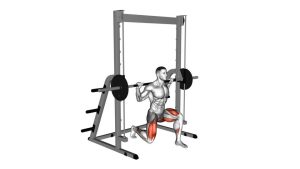
Smith Machine Rear-Foot Elevated Split Squat
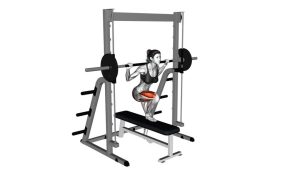
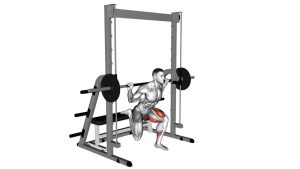
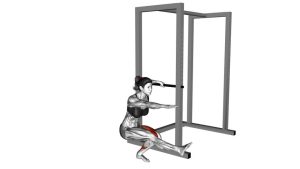
This movement is excellent for building single-leg strength, improving lower-body symmetry, and increasing glute and quad tension without needing as much balance as a free-weight Bulgarian split squat. The goal is to descend under control, keep the front foot planted, allow the back knee to travel down naturally, and drive upward through the front leg.
Quick Overview
| Body Part | Legs |
|---|---|
| Primary Muscle | Gluteus maximus, quadriceps |
| Secondary Muscle | Hamstrings, adductors, calves, core stabilizers |
| Equipment | Smith machine, flat bench or elevated platform |
| Difficulty | Intermediate |
Sets & Reps (By Goal)
- Muscle growth: 3–4 sets × 8–12 reps per leg with controlled tempo.
- Strength focus: 4–5 sets × 5–8 reps per leg with heavier loading and full control.
- Glute emphasis: 3–4 sets × 10–15 reps per leg with a slightly longer stance and forward torso lean.
- Quad emphasis: 3–4 sets × 8–12 reps per leg with a more upright torso and moderate knee travel.
- Technique practice: 2–3 sets × 8–10 reps per leg using light weight.
Progression rule: Add reps first, then increase load gradually. Do not increase the weight if your front heel lifts, your hips twist, or you lose control at the bottom.
Setup / Starting Position
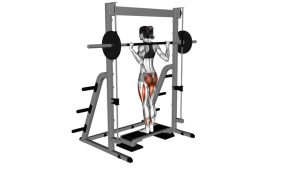
- Set the Smith bar: Position the bar around upper-chest height so it can rest comfortably across your upper traps.
- Place the bench behind you: Use a stable bench or platform for the rear foot. The height should allow a comfortable stretch without forcing the hip.
- Step under the bar: Rest the bar across your upper traps, not directly on your neck.
- Set your front foot: Place one foot forward far enough that your heel stays grounded during the descent.
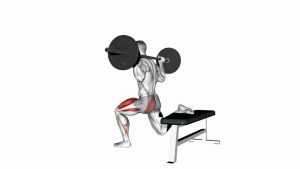
- Elevate the rear foot: Place the top of your rear foot on the bench behind you.
- Brace your core: Keep your ribs down, chest controlled, and spine neutral.
- Unlock the bar: Rotate the Smith bar out of the hooks and stabilize before beginning the rep.
For more glute bias, use a slightly longer stance and a small forward torso lean. For more quad bias, stay more upright and allow controlled knee travel.
Execution (Step-by-Step)
- Begin tall and stable: Keep your front foot flat, rear foot relaxed, and hands evenly gripping the bar.
- Lower under control: Bend the front knee and hip as the rear knee moves down toward the floor.
- Maintain alignment: Keep the front knee tracking in line with the toes. Do not let it collapse inward.
- Reach your working depth: Descend until the front thigh is near parallel or until you reach a comfortable strong range.
- Pause briefly: Avoid bouncing at the bottom. Keep tension in the front leg.
- Drive upward: Push through the front foot and extend the hip and knee together.
- Finish controlled: Return to the top without hyperextending the knee or shifting weight into the rear leg.
- Repeat all reps: Complete the target reps on one side, then switch legs carefully.
Pro Tips & Common Mistakes
- Keep the front heel down: A lifted heel usually means your stance is too short or your control is breaking down.
- Use the rear leg for support, not power: The elevated leg should help balance, not dominate the movement.
- Control the bottom: Do not bounce out of the deepest position. Pause lightly and drive smoothly.
- Avoid hip twisting: Keep both hips squared forward throughout the rep.
- Do not overload too early: The guided bar can make heavy weights feel easier, but poor split-squat mechanics can still stress the knee or hip.
- Adjust stance for your goal: Longer stance and slight forward lean increase glute involvement; shorter stance and upright posture increase quad demand.
- Keep your torso organized: Avoid excessive arching, rib flare, or collapsing forward.
- Use consistent depth: Every rep should look controlled and repeatable.
FAQ
Is the Smith Machine Rear-Foot Elevated Split Squat the same as a Bulgarian split squat?
It is very similar. The main difference is that the Smith machine guides the bar path, which reduces balance demands and lets you focus more on leg drive, depth, and muscle tension.
What muscles does this exercise work most?
It primarily trains the glutes and quadriceps of the front leg. The hamstrings, adductors, calves, and core also assist with stability and control.
Is this better for glutes or quads?
It can target both. A longer stance with a slight forward lean usually emphasizes the glutes, while a more upright torso and moderate knee travel usually increase quad involvement.
Why does my rear leg feel too much work?
Your front foot may be too close, or you may be pushing off the bench with the rear foot. Move the front foot slightly forward and focus on driving through the front heel and midfoot.
Should beginners do this exercise?
Beginners can use it if they start light and learn the stance carefully. However, a regular split squat or assisted bodyweight split squat may be easier before progressing to the rear-foot elevated version.
Recommended Equipment
- Smith Machine — provides a guided bar path for controlled split squat training.
- Flat Weight Bench — used to elevate the rear foot during the split squat.
- Barbell Squat Pad — adds comfort when the Smith bar rests across the upper traps.
- Weightlifting Shoes — improve foot stability and help maintain strong pressure through the front foot.
- Exercise Mat — useful for knee comfort during setup, warm-ups, or mobility work.
Tip: Equipment should support better control, not compensate for poor setup. Master your stance and depth before adding heavier loads.