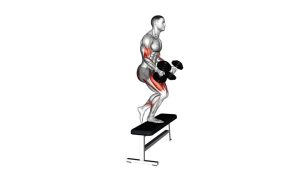
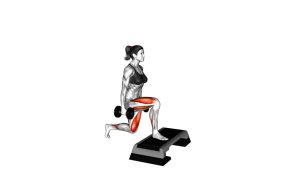
Dumbbell Single-Leg Step-Up: Form, Sets, Muscles & Tips
Learn the Dumbbell Single-Leg Step-Up to build stronger quads, glutes, balance, and leg power with proper setup, form cues, mistakes, and sets.
Dumbbell Single-Leg Step-Up
This exercise is excellent for building balanced leg strength because each side works independently. It helps improve lower-body coordination, knee tracking, hip stability, and real-world climbing strength. Since the dumbbells stay at your sides, the movement also challenges grip, posture, and core control without requiring a barbell.
Quick Overview
| Body Part | Legs |
|---|---|
| Primary Muscle | Quadriceps |
| Secondary Muscle | Glutes, hamstrings, calves, core, hip stabilizers |
| Equipment | Dumbbells and a stable step, box, or bench |
| Difficulty | Intermediate |
Sets & Reps (By Goal)
- Muscle growth: 3–4 sets × 8–12 reps per leg, using moderate dumbbells and controlled tempo.
- Strength: 4–5 sets × 5–8 reps per leg, using heavier dumbbells while keeping full control.
- Balance and control: 2–3 sets × 10–15 reps per leg, using lighter dumbbells or bodyweight.
- Lower-body conditioning: 3–4 sets × 12–20 reps per leg, using lighter weight and shorter rest.
Progression rule: Increase platform control first, then reps, then dumbbell weight. Do not increase the load if your knee collapses inward, your rear leg pushes too much, or your descent becomes uncontrolled.
Setup / Starting Position
- Choose a stable platform: Use a step, plyo box, or bench that does not move during the exercise.
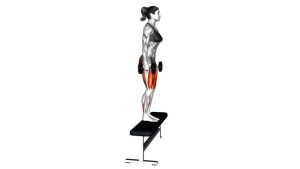
- Hold the dumbbells: Grip one dumbbell in each hand with your arms straight at your sides.
- Stand tall: Keep your chest lifted, ribs stacked, shoulders relaxed, and eyes forward.
- Set your stance: Stand close enough to the platform so the lead foot can land fully on top without reaching too far.
- Place the working foot: Put your full foot on the platform, keeping the heel down and the knee aligned with the toes.
Tip: A lower platform is better for clean form. A box that is too high often causes excessive forward lean, hip shifting, or rear-leg pushing.
Execution (Step-by-Step)
- Plant the lead foot: Place one foot flat on the platform with the heel secure and the knee pointing in the same direction as the toes.
- Brace lightly: Tighten your core enough to keep your torso stable without holding your breath too aggressively.
- Drive through the working leg: Push through the heel and midfoot of the lead leg to lift your body upward.
- Limit rear-leg assistance: The back foot should help balance, not launch you upward.
- Reach the top position: Stand tall on the platform with the hip and knee extended, keeping the dumbbells controlled at your sides.
- Lower with control: Step down slowly with the same leg working to control the descent.
- Reset before the next rep: Regain balance, keep posture tall, and repeat for the target reps before switching legs.
Pro Tips & Common Mistakes
- Use the full foot: Do not step up from the toes only. A full-foot position gives better stability and force transfer.
- Drive through the lead heel: This keeps tension on the quads and glutes instead of turning the movement into a calf push-off.
- Keep the knee aligned: Avoid letting the working knee collapse inward as you stand up or lower down.
- Control the descent: The lowering phase builds strength and protects the joints. Do not drop quickly to the floor.
- Avoid excessive forward lean: A slight lean is normal, but folding over shifts tension away from the target muscles.
- Do not bounce from the rear leg: If the rear foot is doing most of the work, the exercise loses its single-leg benefit.
- Keep dumbbells steady: Swinging weights create momentum and reduce muscle tension.
FAQ
What muscles does the Dumbbell Single-Leg Step-Up work?
The main muscle worked is the quadriceps. The glutes, hamstrings, calves, core, and hip stabilizers also assist during the lift and help control balance.
Is the Dumbbell Single-Leg Step-Up good for building muscle?
Yes. It is especially useful for building unilateral leg strength and improving left-to-right balance. Use controlled reps, enough range of motion, and progressive dumbbell loading for hypertrophy.
How high should the step be?
Use a height that allows your lead foot to stay flat and your knee to remain controlled. For most people, knee height or slightly below knee height works well. Beginners should start lower.
Should I alternate legs or complete one side first?
Both methods work. Completing one side first creates more local fatigue and is useful for muscle growth. Alternating sides can feel more balanced and is useful for conditioning or general training.
Why do I feel this more in my rear leg?
You are likely pushing off the floor too much. Place more pressure through the lead heel and midfoot, slow the movement down, and use a lower platform if needed.
Recommended Equipment
- Adjustable Dumbbells — ideal for progressing weight without needing multiple dumbbell pairs.
- Plyo Box / Step-Up Box — provides a stable raised surface for step-ups and lower-body training.
- Adjustable Aerobic Step Platform — useful for beginners because the height can be adjusted gradually.
- Weightlifting Shoes — helps provide a stable base and better foot pressure during loaded step-ups.
- Non-Slip Exercise Mat — helps reduce floor slipping when placing a step platform in a home gym.
Tip: Choose equipment that stays stable under load. A moving or unstable platform increases the risk of poor knee tracking and balance loss.