Dumbbell Over Bench Reverse Wrist Curl: Form, Sets, Tips & FAQ
Learn the Dumbbell Over Bench Reverse Wrist Curl to strengthen the forearm extensors with strict wrist-focused form. Includes setup, execution, sets by goal, common mistakes, FAQs, and recommended equipment.
Dumbbell Over Bench Reverse Wrist Curl
This exercise works best with strict form, a controlled tempo, and a weight you can move without swinging. Because the forearm stays braced on the bench, the wrist extensors have to do the work instead of the shoulder or elbow helping out. You should feel the effort mainly across the top side of the forearm, not in the shoulder or upper arm.
Quick Overview
| Body Part | Forearms |
|---|---|
| Primary Muscle | Forearm extensors |
| Secondary Muscle | Brachioradialis, wrist stabilizers, finger extensors |
| Equipment | Dumbbell, flat bench |
| Difficulty | Beginner to Intermediate |
Sets & Reps (By Goal)
- Muscle growth: 3–4 sets × 10–15 reps per arm with 45–75 sec rest
- Forearm endurance: 2–4 sets × 15–20 reps per arm with 30–60 sec rest
- Strength/control focus: 3–5 sets × 8–12 reps per arm with a slower lowering phase
- Finisher after arm day: 2–3 sets × 12–20 reps with strict form and no momentum
Progression rule: Add reps first, then increase load in small jumps. If your forearm lifts off the bench or your elbow starts moving, the weight is too heavy.
Setup / Starting Position
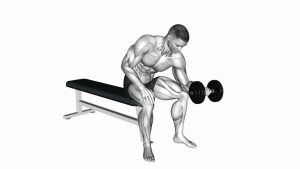
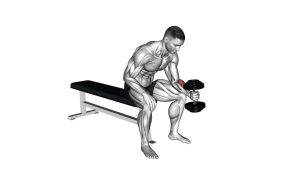
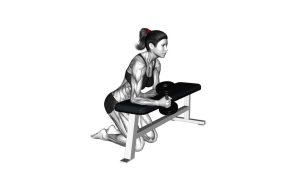
- Set the bench height: Use a flat bench that allows your forearm to rest comfortably with the wrist hanging just off the edge.
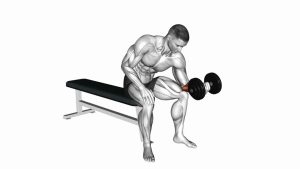
- Take a pronated grip: Hold a dumbbell with your palm facing down.
- Support the forearm: Place the forearm across the bench so the elbow and forearm stay planted.
- Let the wrist hang naturally: The hand should extend slightly past the bench edge to allow full wrist movement.
- Set your body: Keep your torso still, shoulders relaxed, and eyes on the working hand if that helps maintain control.
Tip: Keep the grip firm enough to control the dumbbell, but not so tight that you create unnecessary tension in the hand and shoulder.
Execution (Step-by-Step)
- Start from the stretch: Let the wrist lower into a comfortable stretched position with the dumbbell under control.
- Extend the wrist upward: Lift the back of the hand toward the top of the forearm without moving the elbow or shoulder.
- Pause briefly at the top: Squeeze the forearm extensors for a short peak contraction.
- Lower slowly: Return the dumbbell to the starting position under full control.
- Repeat smoothly: Keep each rep small, clean, and driven only by wrist extension.
Pro Tips & Common Mistakes
- Keep the forearm glued to the bench: This prevents cheating and keeps the wrist extensors loaded.
- Use a slower eccentric: Lowering the dumbbell with control improves tension and makes light weights more effective.
- Don’t turn it into a shoulder movement: The upper arm should stay quiet from start to finish.
- Don’t overload too early: Reverse wrist curls usually require less weight than standard wrist curls.
- Avoid snapping the wrist: Smooth reps are safer and better for muscular stimulus.
- Train both sides evenly: Match reps and control on each arm to reduce imbalances.
- Pair it smartly: This exercise works well after reverse curls, hammer curls, or grip work.
FAQ
What muscles does the Dumbbell Over Bench Reverse Wrist Curl work?
It mainly targets the forearm extensors, which run along the top side of the forearm and control wrist extension. Supporting the arm on the bench helps isolate them more effectively.
Should I go heavy on reverse wrist curls?
Usually no. This movement responds well to lighter loads, clean reps, and controlled tempo. Going too heavy often reduces range, adds momentum, and shifts stress away from the target muscles.
How is this different from a regular wrist curl?
A regular wrist curl trains wrist flexion and emphasizes the forearm flexors, while a reverse wrist curl trains wrist extension and emphasizes the extensor side of the forearm.
Can beginners use this exercise?
Yes. It is beginner-friendly as long as you start light, support the forearm well, and focus on precise movement rather than chasing heavy weight.
Where should I feel it?
You should feel it mostly along the top of the forearm. If you feel more strain in the shoulder, elbow, or wrist joint than in the muscle, adjust the weight and form.
Recommended Equipment
- Adjustable Dumbbells — the main loading tool for progressing reverse wrist curls efficiently at home
- Flat Weight Bench — provides the stable arm support needed to isolate the wrist and forearm properly
- Wrist Roller — useful as a complementary forearm-strength tool alongside reverse wrist curls
- Weightlifting Wrist Wraps — can add wrist support for lifters who want more stability during arm and forearm sessions
- Grip Strength Trainer — a simple accessory for extra hand, wrist, and forearm work between full workouts
These equipment categories are commonly available on Amazon for forearm and wrist training, including adjustable dumbbells, wrist rollers, wrist wraps, grip trainers, and flat benches. Amazon search and best-seller pages currently show these as active product categories for strength training and wrist/forearm work.