Dumbbell Reverse Preacher Curl: Proper Form, Sets, Tips & FAQ
Learn the Dumbbell Reverse Preacher Curl for stricter forearm and brachioradialis training. Discover proper form, setup, sets by goal, common mistakes, FAQs, and recommended equipment.
Dumbbell Reverse Preacher Curl
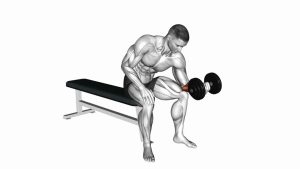
This movement works best when performed with a moderate load, a full but controlled range of motion, and a steady eccentric. Because the reverse grip weakens the biceps’ mechanical advantage, lighter weights often produce better form and stronger forearm activation than going too heavy. Keep your chest supported, wrists mostly neutral, and focus on clean elbow flexion.
Quick Overview
| Body Part | Forearms |
|---|---|
| Primary Muscle | Brachioradialis |
| Secondary Muscle | Forearm extensors, brachialis, biceps brachii (assisting) |
| Equipment | Dumbbell, preacher bench |
| Difficulty | Beginner to Intermediate |
Sets & Reps (By Goal)
- Forearm muscle growth: 3–4 sets × 8–15 reps, 60–90 sec rest
- Strength-focused arm work: 3–5 sets × 6–8 reps, 90–120 sec rest
- Technique and control: 2–3 sets × 10–12 reps, slow eccentric, 45–75 sec rest
- Finisher after arm day: 2–3 sets × 12–20 reps, moderate load, short rest
Progression rule: Add reps before adding load. Once you can hit the top of your rep range with strict preacher-bench form and no swinging, increase the dumbbell slightly.
Setup / Starting Position
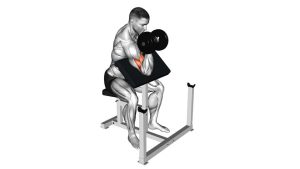
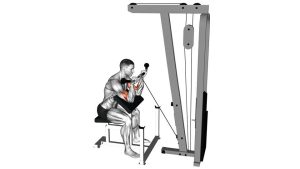
- Adjust the preacher bench: Set the pad height so your armpits sit comfortably near the top edge while your upper arms stay fully supported.
- Take a pronated grip: Hold the dumbbell with your palm facing down and your knuckles pointing forward.
- Anchor the upper arm: Press the back of the upper arm into the pad and keep the elbow fixed in place.
- Start near full extension: Lower the dumbbell until your arm is almost straight, but do not force a harsh lockout.
- Set the wrist: Keep it mostly neutral with only a slight natural extension under load.
Tip: A lighter dumbbell usually improves reverse-grip mechanics and keeps tension on the target muscles instead of shifting stress into the wrist and elbow.
Execution (Step-by-Step)
- Brace and lock in: Keep your chest against the bench, shoulders quiet, and upper arm glued to the pad.
- Curl the dumbbell upward: Bend at the elbow and raise the weight smoothly without letting the elbow drift or the shoulder roll forward.
- Keep the grip pronated: Do not rotate the hand into a supinated curl as the dumbbell rises.
- Squeeze at the top: Pause briefly when the forearm reaches the highest controlled position.
- Lower slowly: Control the eccentric all the way back down until you return to the stretched starting position.
- Repeat cleanly: Every rep should look nearly identical, with no bouncing off the bottom.
Pro Tips & Common Mistakes
- Use strict preacher-bench contact: The pad should remove momentum, not become a setup for cheating.
- Control the eccentric: The lowering phase is a major driver of tension for the forearms and brachioradialis.
- Keep the wrist stacked: Too much wrist extension can shift stress away from the target area and irritate the joint.
- Don’t go too heavy too early: Reverse curls are harder than standard curls, so ego-loading usually ruins the movement.
- Use a moderate range if needed: If your elbows are sensitive, avoid forcing a completely straightened bottom position.
- Pair it wisely: This exercise works well after hammer curls, wrist curls, reverse curls, or general arm training.
- Avoid shoulder assistance: Once the shoulder starts helping, the preacher bench is no longer doing its job.
FAQ
What muscles does the dumbbell reverse preacher curl target most?
The main target is the brachioradialis, with strong assistance from the forearm extensors and brachialis. The pronated grip reduces biceps dominance compared with a regular preacher curl.
Is this more of a forearm exercise or a biceps exercise?
It leans more toward forearm and brachioradialis emphasis than a standard preacher curl. The biceps still help, but they are less mechanically favored.
Should I use one arm or two arms?
A one-arm version is often easier to control and helps you match range and tempo side to side. If your setup allows it, unilateral work is excellent for precision.
How heavy should I go?
Start lighter than you would for a regular curl. Choose a weight that lets you keep a pronated grip, full control, and a slow lowering phase without wrist collapse.
Can beginners use this exercise?
Yes. Beginners can use it effectively as long as they keep the load modest, maintain strict positioning, and avoid forcing range or speed.
Recommended Equipment
- Adjustable Dumbbells — practical for progressive loading without needing multiple fixed dumbbells
- Preacher Curl Bench — provides the stable arm support needed for strict reverse preacher curls
- Thick Dumbbell Grips / Fat Grips — can increase grip demand and forearm involvement during accessory work
- Wrist Wraps — useful if you want extra wrist support while keeping the reverse grip more stable
- Lifting Straps — optional for other forearm and pulling accessories when grip fatigue limits total training volume
Tip: For this exercise, the most important tools are a comfortable preacher bench and a dumbbell you can control strictly. Wrist-support accessories are optional, not mandatory.