Sitting Flutter Kick on a Padded Stool: Core Form, Sets, Tips & FAQ
Learn the Sitting Flutter Kick on a padded stool to train lower abs, hip flexors, and core control with proper form, sets, tips, FAQs, and gear.
Sitting Flutter Kick on a Padded Stool
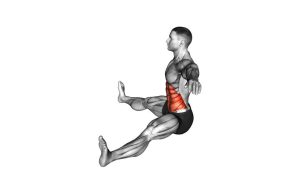
This exercise is useful when you want to train your lower abs, hip flexors, and trunk stability without lying on the floor. First, the padded stool gives you a raised seated position. Then, the slight backward lean increases the core challenge. Finally, the alternating flutter motion teaches you to keep the torso steady while the legs move continuously.
Quick Overview
| Body Part | Core |
|---|---|
| Primary Muscle | Lower abs, especially the rectus abdominis with strong hip-flexor assistance |
| Secondary Muscle | Hip flexors, quadriceps, deep core stabilizers, and trunk stabilizers |
| Equipment | Padded stool, padded bench, or stable seated surface |
| Difficulty | Beginner to intermediate, depending on leg height, tempo, and set duration |
Sets & Reps (By Goal)
- Beginner core control: 2–3 sets × 10–20 seconds, slow flutter rhythm, 45–60 seconds rest.
- Core endurance: 3–4 sets × 20–40 seconds, steady tempo, 45–75 seconds rest.
- Lower-ab focus: 3 sets × 12–20 alternating kicks per side, controlled height, 60 seconds rest.
- Workout finisher: 2–3 rounds × 30 seconds, smooth continuous movement, 30–45 seconds rest.
Progression rule: Add time before adding speed. Also, keep the torso steady before increasing leg range.
Setup / Starting Position
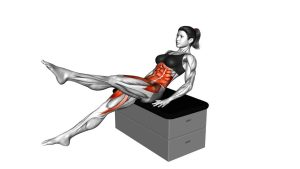
- Sit on a padded stool: Use a stable padded stool or bench that does not slide during the movement.
- Place your hands for support: Position your hands beside or slightly behind your hips to help balance your torso.
- Lean slightly back: Keep your chest lifted while creating a small backward angle through the torso.
- Extend your legs forward: Keep the knees mostly straight with a soft natural bend.
- Lift both feet off the floor: Brace your core before starting so the legs hover without pulling your back out of position.
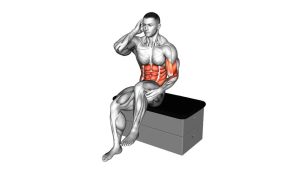
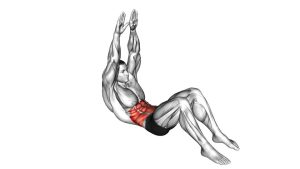
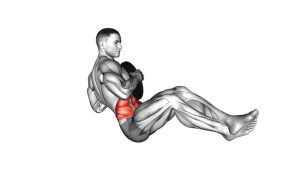
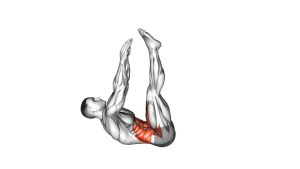
The video shows a supported seated position with the torso slightly leaned back and the legs hovering before the flutter motion begins.
Execution (Step-by-Step)
- Brace your midsection: Tighten your core gently and keep your upper body quiet.
- Start the flutter motion: Lift one leg slightly while the other leg lowers slightly.
- Alternate smoothly: Switch legs in a steady up-and-down rhythm without letting either foot touch the floor.
- Keep the kicks compact: Use a moderate range of motion rather than large swinging kicks.
- Maintain posture: Keep your shoulders relaxed, hands stable, and torso from rocking.
- Finish with control: Slow the legs down before placing the feet back on the floor.
Pro Tips & Common Mistakes
- Use your hands as support, not as a crutch: Press lightly into the stool while your core controls the position.
- Keep both legs hovering: Touching the floor removes tension from the abs and reduces the training effect.
- Avoid kicking too high: Large kicks often create momentum instead of clean core control.
- Do not round and collapse: Keep the chest open enough to prevent the lower back from taking over.
- Control the tempo: A steady rhythm is better than rushing through uncontrolled reps.
- Relax the shoulders: Avoid shrugging while your hands hold the stool for balance.
- Stop before form breaks: Once the torso starts swinging, the set has likely gone too long.
FAQ
What muscles does the Sitting Flutter Kick on a Padded Stool work?
It mainly trains the lower abs and hip flexors. Additionally, the deep core stabilizers work to keep the torso steady while the legs alternate.
Is this exercise good for beginners?
Yes, it can be beginner-friendly when performed with a short duration and small kicks. However, beginners should start slowly and stop before the lower back feels strained.
Should my legs stay straight?
Your legs should stay mostly extended, but a small natural bend in the knees is fine. The goal is controlled fluttering, not locked-out stiffness.
Why do I feel this in my hip flexors?
The hip flexors help hold and move the legs in the air. However, if they dominate too much, reduce the range, slow down, and focus on bracing the abs.
How can I make the exercise easier?
Lean back less, shorten the set, lower the leg height, or use smaller kicks. Also, you can briefly rest between short rounds instead of forcing one long set.
How can I make it harder?
Increase the set duration, slow the tempo, keep the legs slightly lower, or reduce hand pressure. Still, only progress when your torso remains stable.
Recommended Equipment
- Padded Workout Stool — useful for seated core drills and supported bodyweight exercises.
- Adjustable Weight Bench — gives a stable padded surface for seated and lying core movements.
- Non-Slip Exercise Mat — helps keep the stool or bench area safer during home workouts.
- Light Ankle Weights — optional progression tool for advanced users only after bodyweight control is strong.
- Core Sliders — useful for pairing this exercise with other core stability drills.
Tip: Start with only a stable padded stool or bench. Add resistance later only if your lower back stays comfortable and your flutter rhythm stays controlled.