Lever Triceps Extension: Proper Form, Sets, Tips & FAQ
Learn the Lever Triceps Extension for stronger, more defined triceps. Discover proper form, setup, execution, sets by goal, common mistakes, FAQs, and recommended Amazon equipment.
Lever Triceps Extension
This exercise is excellent for building triceps size, improving lockout strength, and adding safe isolation work to upper-body sessions. Because the machine guides the resistance path, it can help beginners learn clean elbow extension mechanics while also allowing advanced lifters to push close to failure with less balance demand than free-weight variations.
Quick Overview
| Body Part | Triceps |
|---|---|
| Primary Muscle | Triceps brachii |
| Secondary Muscle | Forearms and anterior deltoids as stabilizers |
| Equipment | Lever triceps extension machine |
| Difficulty | Beginner to Intermediate |
Sets & Reps (By Goal)
- Muscle growth: 3–4 sets × 8–15 reps with 45–75 seconds rest
- Strength-focused isolation: 3–5 sets × 6–10 reps with 75–120 seconds rest
- Technique and control: 2–3 sets × 10–15 reps with slow tempo and moderate load
- Finisher / pump work: 2–3 sets × 12–20 reps with short rest and constant tension
Progression rule: Increase load only when you can complete all target reps with smooth control, stable elbows, and no bouncing at the bottom or lockout.
Setup / Starting Position
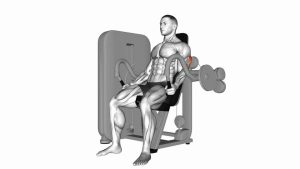
- Adjust the machine: Set the seat so the handles line up comfortably with your hands and your elbows can move naturally through the machine’s path.
- Sit tall: Place your back against the pad and plant your feet firmly on the floor.
- Grip the handles: Use a secure grip while keeping the wrists as neutral as possible.
- Position your arms: Start with elbows bent and upper arms fixed in place. They should not swing forward and backward during the rep.
- Brace lightly: Tighten your core and keep your shoulders down to avoid shrugging or using body momentum.
Tip: Before starting your working set, do one light warm-up set to check machine alignment and elbow comfort.
Execution (Step-by-Step)
- Start from the bent-elbow position: Let the triceps stay loaded while keeping your chest up and upper arms steady.
- Extend the elbows: Push the handles through the working range by straightening your arms under control.
- Squeeze at the top: Reach near full extension without aggressively snapping into lockout.
- Pause briefly: Hold the contraction for a moment to maximize triceps engagement.
- Return slowly: Bend the elbows in a controlled eccentric phase until you reach a comfortable stretch at the bottom.
- Repeat with strict form: Keep tension on the triceps and avoid turning the rep into a whole-body press.
Pro Tips & Common Mistakes
- Keep upper arms still: The more the elbows drift, the less isolated the triceps become.
- Don’t slam lockout: Finish the rep strongly, but avoid snapping the elbows straight with force.
- Control the negative: A slow eccentric improves tension and usually produces a better hypertrophy stimulus.
- Avoid excessive weight: Too much load often turns the movement into a shortened, momentum-based rep.
- Keep wrists neutral: Overbending the wrists can create unnecessary strain and reduce force transfer.
- Use full working range: Partial reps can be useful later, but your base sets should emphasize controlled range of motion.
- Don’t shrug: Keep the shoulders down and relaxed so the triceps remain the main driver.
FAQ
What muscles does the Lever Triceps Extension work?
It primarily targets the triceps brachii, the main muscle group on the back of the upper arm. The forearms and shoulders help stabilize the movement, but the exercise is mainly an elbow-extension isolation drill.
Is the Lever Triceps Extension good for beginners?
Yes. The machine provides stability and a guided movement path, which makes it easier for beginners to learn proper triceps isolation without balancing free weights.
Should I fully lock out my elbows?
You can reach near full extension, but avoid violently snapping into lockout. Focus on a controlled finish and strong triceps squeeze instead.
Where should I feel this exercise?
You should feel the work mainly in the triceps. If you feel more strain in the wrists, shoulders, or elbows, review your setup, reduce the load, and slow the tempo.
Can I use this exercise for muscle growth?
Absolutely. It is a strong hypertrophy exercise because it allows consistent tension, stable body position, and easy progression in rep ranges commonly used for triceps development.
Recommended Equipment
- Weightlifting Elbow Sleeves — helpful for warmth, joint comfort, and support during pressing and extension work
- Gym Lifting Gloves — improve grip comfort on machine handles and reduce palm irritation
- Weightlifting Wrist Wraps — useful if you want extra wrist stability during heavy machine arm work
- Microfiber Gym Towel — keeps hands and machine contact points dry for a more secure setup
- Workout Log Book — helps track load, reps, tempo, and progression over time
Tip: Accessories should improve comfort and consistency, but your results still depend most on good technique, progressive overload, and quality recovery.