Reverse-Grip Cable Triceps Pushdown: Form, Muscles Worked, Sets & Tips
Learn how to do the Reverse-Grip Cable Triceps Pushdown with an SZ bar for strict triceps isolation. Includes setup, execution, muscles worked, sets by goal, common mistakes, FAQs, and recommended equipment.
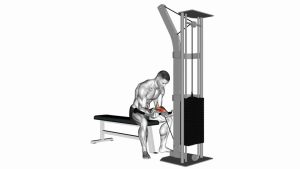
Reverse-Grip Cable Triceps Pushdown (SZ Bar)
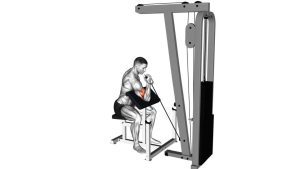
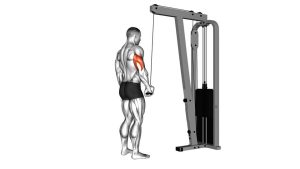
This exercise works best when performed with strict form, a moderate load, and a deliberate tempo. The reverse grip often feels more natural on the wrists for some lifters and can improve awareness of the medial head of the triceps. Keep the chest up, shoulders down, and avoid turning the movement into a full-body push. The bar should travel smoothly from around lower chest level to near the upper thighs.
Quick Overview
| Body Part | Triceps |
|---|---|
| Primary Muscle | Triceps brachii |
| Secondary Muscle | Forearms, wrist stabilizers, core stabilizers |
| Equipment | Cable machine, high pulley, SZ / EZ bar cable attachment |
| Difficulty | Beginner to Intermediate |
Sets & Reps (By Goal)
- Muscle growth: 3–4 sets × 8–15 reps with 45–75 sec rest
- Strength-focused accessory work: 3–5 sets × 6–10 reps with 60–90 sec rest
- Technique / mind-muscle connection: 2–3 sets × 12–15 reps with slow tempo and light-to-moderate load
- Finisher for arm day: 2–3 sets × 15–20 reps with short rest and strict form
Progression rule: Increase reps first while keeping the elbows fixed and the eccentric controlled. Add weight only when you can fully extend the elbows without torso swing or wrist collapse.
Setup / Starting Position
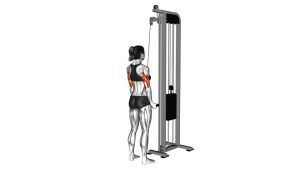
- Attach the bar: Clip an SZ / EZ bar to the high pulley of a cable machine.
- Take an underhand grip: Hold the angled portions of the bar with palms facing up and hands about shoulder-width apart.
- Set your stance: Stand tall with feet hip-width apart and a slight knee bend for balance.
- Position the elbows: Keep them close to your sides and slightly in front of the torso if needed for comfort.
- Brace the torso: Lift the chest, keep the core tight, and pull the shoulders down and back lightly.
- Start at the top: Let the bar sit around lower chest or upper abdomen height with the elbows flexed under control.
Tip: A very small forward lean is fine, but avoid leaning so much that you turn the movement into a pressing motion.
Execution (Step-by-Step)
- Lock in your upper arms: Before each rep, pin the elbows near your torso and keep the shoulders quiet.
- Press the bar down: Extend the elbows and push the bar downward in a controlled arc until your arms are nearly straight.
- Squeeze at the bottom: At full extension, contract the triceps hard for a brief moment without forcing an aggressive hyperextension.
- Return slowly: Let the bar rise back up under control while maintaining elbow position.
- Repeat smoothly: Perform each rep with the same path and tempo instead of bouncing between reps.
Pro Tips & Common Mistakes
- Keep wrists neutral: Don’t let the wrists bend backward too much at the bottom.
- Tuck the elbows: Flared elbows reduce isolation and often shift stress away from the triceps.
- Use full but controlled range: Lower until the triceps are shortened, then return without losing tension at the top.
- Don’t chase load too early: Heavy weight often causes torso swing, shoulder involvement, and sloppy lockout.
- Control the eccentric: The upward return is where many lifters lose tension and technique.
- Avoid shrugging: Keep the neck relaxed and shoulders down to prevent unnecessary upper-trap involvement.
- Use moderate reps well: This exercise usually shines best in the 8–15 rep range with clean execution.
FAQ
What does the reverse grip change in a triceps pushdown?
The reverse grip changes your wrist and forearm position, which can make the movement feel more comfortable for some lifters and may improve awareness of the triceps during the pushdown. It is still fundamentally a triceps isolation exercise.
Which part of the triceps does this exercise target most?
All three heads of the triceps assist with elbow extension, but many lifters feel a strong contraction in the medial head during reverse-grip pushdowns when performed with strict form.
Should I go fully to lockout on every rep?
Yes, aim for a strong near-full extension on each rep, but do not slam into the joint or hyperextend the elbows. Think “squeeze the triceps,” not “snap the arms straight.”
Is an SZ / EZ bar better than a straight bar for this movement?
For many people, yes. The angled grip of an SZ / EZ bar can feel more natural on the wrists and forearms than a fully straight bar, especially when using an underhand grip.
Can beginners use this exercise?
Absolutely. It is beginner-friendly as long as the weight stays manageable and the lifter focuses on elbow control, posture, and a steady tempo.
Recommended Equipment
- EZ Curl Bar Cable Attachment — the most direct match for this exercise; ideal for a more comfortable underhand cable grip
- Triceps Pushdown Bar — useful if you want a dedicated bar attachment for pushdowns and similar cable arm work
- Home Gym Cable Machine — essential if you want to perform pushdowns consistently at home with adjustable resistance
- Weightlifting Wrist Wraps — helpful for added wrist support if the underhand position feels unstable under load
- Weight Stack Pin / Magnetic Gym Pin — a small but useful accessory for quick and secure cable machine weight changes
Tip: For this exercise, prioritize a solid cable setup and comfortable bar attachment before buying extra accessories. Clean mechanics matter more than heavy loading.