Dumbbell Bench Squat: Proper Form, Muscles Worked, Sets, Tips & FAQ
Learn the Dumbbell Bench Squat for stronger quads, glutes, and better squat control. Includes form cues, sets, mistakes, FAQs, and equipment.
Dumbbell Bench Squat
This movement is excellent for building the quadriceps, glutes, and overall squat pattern. Because the bench gives a clear depth target, it works well for beginners, home workouts, strength practice, and anyone who wants better control before progressing to heavier squat variations.
Quick Overview
| Body Part | Legs |
|---|---|
| Primary Muscle | Quadriceps |
| Secondary Muscle | Glutes, hamstrings, adductors, calves, core, spinal stabilizers |
| Equipment | Dumbbells and flat bench |
| Difficulty | Beginner to Intermediate |
Sets & Reps (By Goal)
- Beginner technique: 2–3 sets × 8–10 reps with light dumbbells and slow control.
- Muscle growth: 3–4 sets × 8–12 reps with a controlled 2–3 second lowering phase.
- Strength practice: 4–5 sets × 5–8 reps using heavier dumbbells while keeping clean depth.
- Endurance / conditioning: 2–4 sets × 12–20 reps with moderate weight and short rest.
- Warm-up patterning: 1–2 sets × 8–12 reps using bodyweight or very light dumbbells.
Progression rule: First improve control, depth consistency, and balance. Then increase dumbbell weight gradually. Avoid adding load if you are dropping onto the bench, rounding your back, or letting your knees cave inward.
Setup / Starting Position
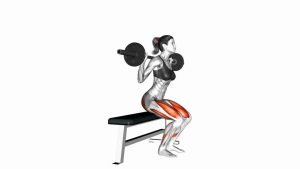
- Place a bench behind you: Use a stable flat bench positioned so your hips can lightly touch it at the bottom of the squat.
- Stand tall in front of the bench: Keep your feet about shoulder-width apart with toes slightly turned out if comfortable.
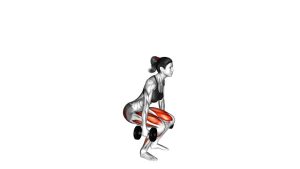
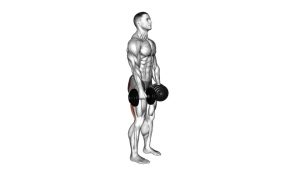
- Hold the dumbbells at your sides: Use a neutral grip with palms facing your thighs and arms relaxed but controlled.
- Brace your core: Keep your ribs stacked, chest open, and spine neutral before starting the descent.
- Set your gaze forward: Look straight ahead or slightly downward at a fixed point to help balance.
Tip: If the bench is too low, your form may break at the bottom. Start with a height that allows good posture, then progress lower only when your control improves.
Execution (Step-by-Step)
- Begin by sending your hips back: Push the hips slightly behind you as your knees begin to bend.
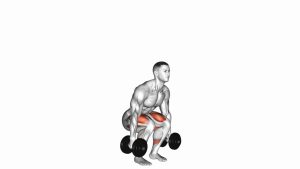
- Lower with control: Keep your torso stable, dumbbells close to your sides, and knees tracking in line with your toes.
- Touch the bench lightly: Let your glutes make brief contact with the bench without fully sitting or losing tension.
- Drive through the floor: Push through the heels and midfoot while extending the knees and hips together.
- Return to standing: Stand tall at the top with your hips fully extended, core braced, and dumbbells still controlled.
Pro Tips & Common Mistakes
- Do not bounce: Bouncing off the bench reduces control and may increase stress on the hips or lower back.
- Keep the dumbbells still: Avoid swinging the weights forward or backward during the squat.
- Control your knees: Keep knees tracking over the toes instead of collapsing inward.
- Use the full foot: Stay balanced through the heel, midfoot, and big toe instead of shifting only to the toes.
- Keep your spine neutral: Do not round your lower back as you approach the bench.
- Choose the right bench height: A higher bench is easier; a lower bench increases range of motion and difficulty.
- Do not overload too soon: Heavy dumbbells only help if your tempo, depth, and balance stay clean.
FAQ
What muscles does the Dumbbell Bench Squat work?
The Dumbbell Bench Squat mainly works the quadriceps and glutes. It also trains the hamstrings, adductors, calves, core, and spinal stabilizers because your body must control the descent and stand up with balance.
Is the Dumbbell Bench Squat good for beginners?
Yes. It is one of the best dumbbell squat variations for beginners because the bench gives a clear target for depth. This makes it easier to learn proper squat mechanics without guessing how low to go.
Should I fully sit on the bench?
For strength and muscle-building purposes, you should usually touch the bench lightly and stand back up without relaxing. Fully sitting down can be useful for sit-to-stand practice, but it reduces continuous muscle tension.
How can I make this exercise harder?
You can use heavier dumbbells, lower the bench height, slow down the lowering phase, add a pause near the bench, or perform more total reps. Only progress when your knees, hips, and torso stay controlled.
Why do I feel this more in my glutes than my quads?
A deeper hip-back position and more forward torso lean can increase glute involvement. To feel more quadriceps, keep the torso slightly more upright, allow the knees to bend naturally, and use a controlled range of motion.
Recommended Equipment
- Adjustable Dumbbells — ideal for progressive overload and changing resistance between sets
- Flat Weight Bench — provides a stable depth target for bench squat practice
- Rubber Hex Dumbbells — strong, stable dumbbells for home or gym lower-body training
- Weightlifting Shoes — useful for improving squat stability and upright positioning
- Resistance Bands for Legs — helpful for glute activation, warm-ups, and knee-tracking drills
Tip: Start with a bench height and dumbbell weight that allow smooth, repeatable reps. Better control produces better results than rushing into heavy loading.