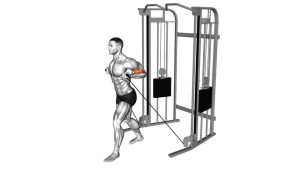
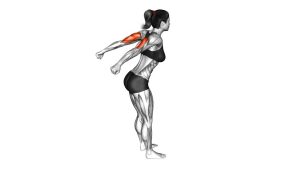
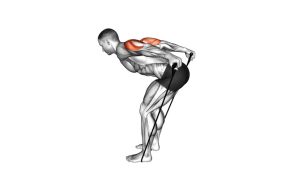
Cable Reverse-Grip Pushdown: Proper Form, Sets, Tips & FAQ
Learn the Cable Reverse-Grip Pushdown to build stronger triceps with strict elbow control and constant cable tension. Includes form tips, sets by goal, common mistakes, FAQs, and recommended equipment.
Cable Reverse-Grip Pushdown
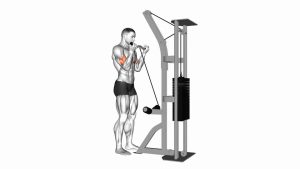
This movement works best when performed with light-to-moderate load and clean mechanics. The goal is to move only through the elbows while keeping the shoulders quiet and the wrists stable. You should feel the triceps doing the work from the top of the rep to full extension at the bottom. If you have to lean over, flare the elbows, or swing the bar down, the weight is likely too heavy.
Quick Overview
| Body Part | Triceps |
|---|---|
| Primary Muscle | Triceps brachii |
| Secondary Muscle | Forearms, wrist flexors, grip stabilizers, anterior delts (light stabilization) |
| Equipment | Cable machine with straight bar attachment |
| Difficulty | Beginner to Intermediate |
Sets & Reps (By Goal)
- Muscle growth: 3–4 sets × 8–15 reps with controlled tempo and full squeeze
- Strength-focused accessory work: 3–5 sets × 6–10 reps with strict form
- Technique / mind-muscle connection: 2–3 sets × 12–15 reps using lighter weight
- Finisher for arm day: 2–3 sets × 15–20 reps with short rest and constant tension
Progression rule: Increase weight only when you can keep your elbows pinned, control the eccentric, and fully extend the arms without using momentum.
Setup / Starting Position
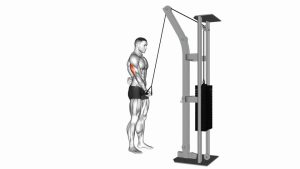
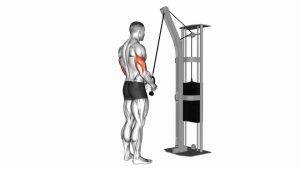
- Set the pulley high: Attach a straight bar to the top pulley of a cable station.
- Take an underhand grip: Grab the bar with palms facing up, hands about shoulder-width apart.
- Stand tall: Keep your chest up, core braced, and feet about hip-width apart for balance.
- Tuck the elbows in: Bring your upper arms close to your sides and keep them there throughout the set.
- Start with the bar high: The bar should be near the lower chest or upper abdomen with the elbows bent.
Tip: A slight forward lean is fine, but your body should stay stable from start to finish.
Execution (Step-by-Step)
- Brace and set the elbows: Lock your upper arms to your sides and keep the shoulders down.
- Push the bar down: Extend the elbows and drive the bar toward your upper thighs using the triceps.
- Squeeze at the bottom: Reach full extension without slamming into lockout. Pause briefly and contract the triceps hard.
- Return with control: Let the bar rise slowly back to the starting position while keeping tension on the triceps.
- Repeat smoothly: Maintain the same elbow path and avoid torso movement on every rep.
Pro Tips & Common Mistakes
- Keep the elbows glued in: Elbow drift reduces triceps isolation and turns the movement into a shoulder-assisted push.
- Use a manageable load: Reverse grip is usually weaker than overhand, so strict form matters more than heavy weight.
- Control the eccentric: Don’t let the cable yank the bar back up. The lowering phase builds more tension and control.
- Don’t curl the bar: This is not a forearm curl. Keep the wrists mostly neutral and let the elbows do the movement.
- Avoid leaning on the stack: Swinging or dipping the torso usually means the load is too heavy.
- Pause at full extension: A brief squeeze at the bottom improves triceps engagement.
FAQ
What muscles does the cable reverse-grip pushdown work?
It primarily works the triceps brachii. The reverse grip also increases the involvement of the forearms and grip stabilizers because the underhand position is less mechanically strong than a standard overhand grip.
Is reverse-grip pushdown better than regular pushdowns?
Not necessarily better, just different. Reverse-grip pushdowns can feel more controlled for some lifters and may help emphasize strict elbow extension, but most people will use less weight than on a standard overhand pushdown.
Should I lock out fully at the bottom?
Yes, but do it under control. Fully extend the elbows and squeeze the triceps without snapping harshly into lockout.
Why do my wrists feel uncomfortable during this exercise?
The underhand grip can stress the wrists if flexibility, grip position, or load selection is poor. Try a lighter load, keep the wrists straighter, and make sure your grip width feels natural rather than forced.
Where should this exercise go in my workout?
It works well in the middle or toward the end of an upper-body or arm workout after heavier compound presses, especially when your goal is extra triceps volume and isolation.
Recommended Equipment (Optional)
- Straight Bar Cable Attachment — the standard attachment for reverse-grip pushdowns and other cable arm work
- Cable Machine / Functional Trainer — essential for performing pushdowns with smooth adjustable resistance
- Wrist Wraps — useful if the underhand grip feels unstable or your wrists need extra support
- Lifting Gloves — can improve grip comfort on cable attachments during higher-rep arm sessions
- Resistance Bands Set — a practical backup option for triceps work when a cable machine is not available
Tip: For most lifters, the best upgrade is a solid straight-bar attachment with smooth cable movement and a comfortable grip diameter.